Friday, February 26, 2010

Chilly Grove


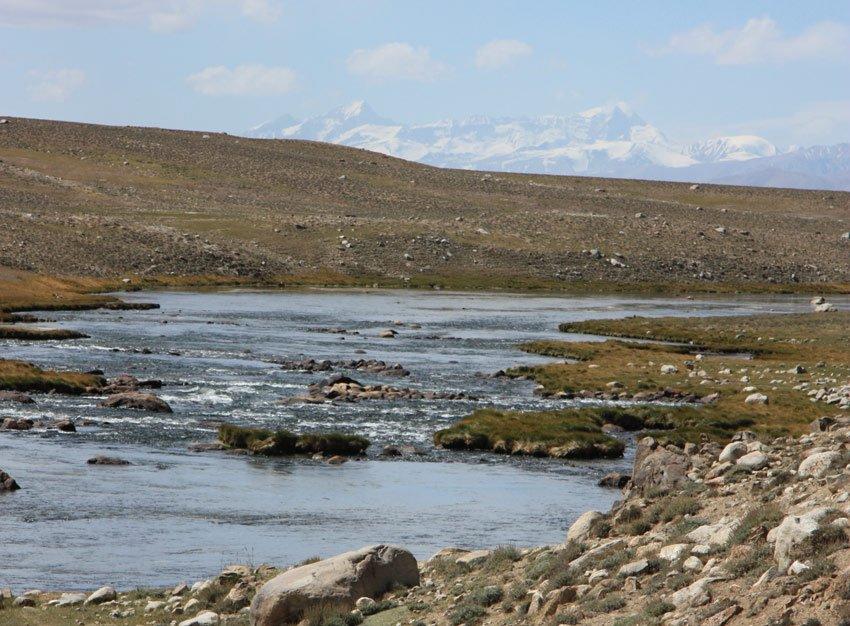
 Amu Darya (formerly Oxus) River with the Pamir Range on the horizon

The new moon in early February marks the beginning of the Tibetan year of the Iron Tiger. In the Nyingma tradition of Vajrayana Buddhism, one day each month is marked to celebrate the life and teachings of Guru Padmasambhava, the tantric master who came to Tibet in the 8th century and helped establish Buddhism in the Land of Snows. The tenth of each lunar month is designated a white day when practice and a ritual feast centers on a period in the life of this great teacher. Eight of these emanations are traditionally grouped together and often individually depicted as the main subject in thangkas. The other four, though not as well known, also derive from Guru Rinpoche's biography. The order in which these emanations appear throughout the year does not reflect a chronological unfolding of events in Padmasambhava's life but is presented as a way to contemplate the manner in which the extraordinary energy of transcendent awakening is expressed amidst the conventions of human society. A text composed by His Holiness Dudjom Rinpoche states,
The First Month: On the Tenth Day of the month of the Hare, having renounced His kingdom, He practices austerities, yoga, and liberation in the great cremation ground of Sitavana, "the cool forest." At the time of gathering all the Matrikas and Dakinis under His power, He became known as Guru Santaraksita, "the Guru who is the guardian of peace."
So the first form indicated in the sequence is not a birth story but instead focuses on the immediacy of the young prince dropping out of courtly life, walking away from the power and pleasures of the kingdom and taking up residence in a cremation ground. Demonstrating a fierce determination to abandon all worldly ambitions marks this course of action, liberating energy and attention to initiate the yogic process of purification culminating in ego-death and full awakening to ground awareness

On the outer level, the appellation 'Santarakshita' echoes the name of Padma's enlightened cohort, the abbot of Nalanda and their work together with King Trisong Deutsen introducing Vajrayana Buddhism to Tibet. The name Santarakshita is Sanskrit and may be translated as 'peace-protector'. On the inner level, this reflects an intensity of resolve to break through the social and psycho-emotional confines of worldly involvement where there is no peace or lasting contentment and to re-orient and transform body and mind in the light of dharma. According to the Padma bKa'i thang, "Now the Prince who was the best of men thought: "By assuming the throne, I will not ensure the good of human beings; they will fall in great numbers into the abyss of perdition. I will find a means of renouncing the kingdom."


The exact location of Urgyen is still not precisely known. While some believe it to have been in the Swat Valley of Pakistan, I am of the opinion that it was more likely a small kingdom situated near the delta of the Oxus River, south of the Aral Sea. Having left the palace at Oddiyana, Padma hastens southeast,on a 'marvelous horse.' Following the Oxus upstream, he would ride for a few weeks before arriving in the town of Termiz in present day Uzbekistan. Here the trails leave the river valley and heads south, ascending into the mountains of Afghanistan. Passing through Kabul and the narrows of the Khyber pass, he crosses the Indus River and makes his way to the western end of the Ganges basin. Here, Padma dismounts and occupies a cavern  where he attained "the perfect state" within seven days. Then, thinking of the work ahead, he continues east to the charnel ground known as Chilly Grove, a site not far from Bodhgaya where he will spend the next five years in the presence of a throng of devoted dakinis.

The emanation of Guru Sanataraksita indicates fearless renunciation, the determination to walk away from all pointless involvement and open oneself to the rawness of naked experience, to know mind directly, devoid of hope, fear and pretension. This is where the path begins. Dwelling in the cremation ground of Chilly Grove with his back leaning on the central stupa called Structure Which Give Happiness, Padma reveals his understanding regarding the true nature of self and world and brought the dakinis 'under his sway.' Upon his arrival here, the Orgyen Lingpa's text  refers to him as Padma Gyalpo. Remaining here for five years as master of the dakinis, Dudjom Rinpoche identifies him with the emanation known as Guru Guardian of Peace.


Padma bKa'i Thang  Canto 22
(Dharma, 1978)

Tuesday, February 02, 2010

Mid-winter notes


Here on the Highland Rim, we often get one thin blanket of snow a year, just enough to tease the kids, scare southern motorists and close the schools for a day before it all melts away. Last week we got our once a decade storm. Many big limbs fell and long after the chainsaws had cleared the way, silence and untrammeled snow defined the world outside. The electricity was out for over 40 hours as middle Tennessee was blanketed with five inches of snow followed by an ice storm. We hauled water from the creek, set up a Coleman propane camp stove for cooking, lit candles and tuned up the acoustic. One neighbor offered us fresh eggs (we're vegans), another reminded us of the six bushels of potatoes we stored in his basement and then stayed for white bean soup.

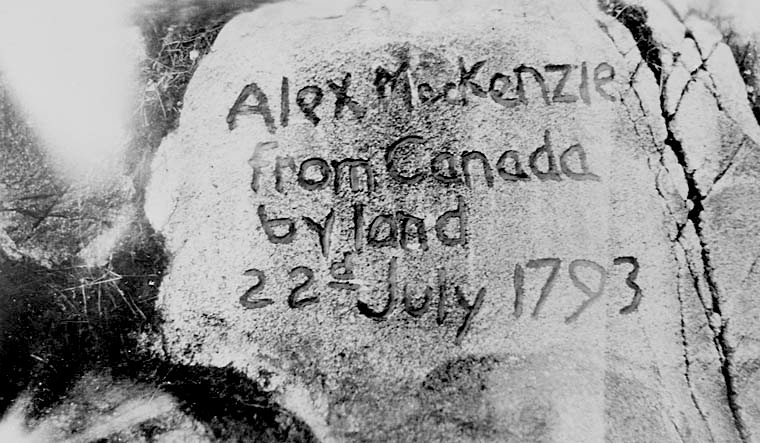
Over morning coffee, I read passages aloud from Bernard De Voto's The Course of Empire (1952) whereby I discovered that Lewis and Clark were not the first white men to traverse the American continent north of Mexico. That distinction belongs to one Sir Alexander Mackenzie who made it to the Pacific Coast early in 1793. His route up the Peace River and over the continental divide to Bella Coola was not commercially viable, but then, neither was Lewis and Clarke's. The fact that we were never taught this fact in school is a good example of American faux-triumphalism.

"The forests of the western slope, much rain, much cold and occasional ice, peaks, cliffs, valleys, marshes, lakes -- and ebbing strength as the food ran out. Indians clustered round them now, eaters and worshipers of the salmon."

-Bernard De Voto

Saturday, July 18, 2009

The Texas Mission

MONDAY, JUNE 29: EL CAMINO

Three of us set out early from Turtle Hill, descending off an eroded highland remnant on the western margins of the Great Eastern Plateau, crossing the Buffalo & Tennessee Rivers and a handful of creeks draining the verdant plains of west Tennessee before ramping up in Memphis onto the Hernando de Soto bridge, 109 feet above the Big Muddy onto Arkansas floodplains green with young soybeans. Arching over the heart of the Mississippi basin, the second biggest drainage in the world with tributaries in 32 states and two Canadian provinces, a watershed encompassing 40 percent of the contiguous United States. At a rest area in Prairie County, land which once served as the Western band of Cherokee Reservation (1812-1836), we break for sandwiches and pass the one-hitter amidst too many flies. By noon we are in motion over the Arkansas on the Little Rock bypass through the ancestral home of the Quapaw, climbing the foothills of the Ouachitas near active geothermal vents, unimpressed by the 'Brick Capital of the World', skirting the mouth of deep crystalline tubes and zipping by a presidential birthplace. Afternoon strings out over miles of unremarkable interstate, crossing the Red River Valley at the point where east flowing water changes direction and begins moving south, as RT's Rumor & Sigh helps us navigate through monotonous corridors of broadleaves.

Mystery wind, are you strong enough
To fight for your right when the time get's tough?
Plague and hunger and burning rain
Too many good men blown away by the mystery wind
The mystery wind

We are entering the former ranges of people known as Caddo, Wichita, Hasinai. Vast open spaces, the simplicity and order of newly planted fields disappear before the double border town of Texarkana, a feast of gas stations, motels, overpasses, restaurants, parking lots, commercial and highway signage, electrical transmission towers, hospitals, rental garages and acres of car lots. 105 air-conditioned miles into Texas, we leave the interstate for two-lane blacktop, eventually passing over the Sabine, unofficial dividing line between Jackson's Old South and the New Southwest of Austin and Houston. No longer in the massive watershed where we began the day, any rain falling in this vast region stretching from dead south to far west, from here to beyond the Rio Grande, drains a separate basin into the Gulf of Mexico. Everything south of the Red River Valley (the border of east TX & OK), from the Sabine (border of TX & LA) to the continental divide in western New Mexico, is the only section of the Great Plains which does not drain into the Mississippi. This marks the natural divide separating French Louisiana from land originally controlled by New Spain. In our general motion today, we are retracing (in reverse) a primary route of agricultural diffusion, from the gardens of northeastern Mexico, across the interior lowlands toward the Mississippi and Tennessee Valleys. Such a trek required a way across these same rivers, complicating the journey while providing rehydration, making an overland route through deserts possible. These seed-carrying trips began sometime around 7000 BCE.

Rainfall in this florid eastern corner of the basin is 3/4 of our average at home. Peaches and watermelons fill tables at roadside stands. Bronzed heads of millet, acres of stunted, browned corn stretch to the horizon. Bypassing Tyler, the Rose Capital of America, named after our 10th president, when a smaller Lone Star was annexed (1845), past the site of Camp Ford, largest Confederate P.O.W. facility west of the Mississippi, before spontaneously contemplating the eternal mystery of afternoon light on open water, crawling in traffic on the causeway over man-made Lake Palestine at day's end, surprised to see this much water anywhere in Texas.

The main employer in Palestine is the prison with almost 4000 workers, followed by Wal-mart with nearly half that number. In 2003, pieces of exploded space shuttle fell in nearby fields. East of town there is a quiet park, a terminal on the Texas State Railroad, now a tourist line. Prices start at $36.50. Originally laid by convicts in 1881, the track was to deliver firewood to a prison iron smelter. We don't have correct change for the campground fee envelope but then nobody comes to check. A persimmon tree, already full of green fruit grows nearby the tent. I read Time-Life's leathery volume, The Texans by light of the Coleman lantern long after dark.


Weeks passed. Sam's mother was distraught; family and neighbors scoured the woods. Eventually, Sam's older brothers, James and John, found him on Hiwassie. He was seated under a tree reading Alexander Pope's translation of the Iliad. Marking his place, he coolly informed them that he, "liked the wild liberty of the Red men better than the tyranny of his own brothers" -- and added that he preferred to read in peace.

For the better part of three years, Houston lived with the Cherokees -- "wandering," as he later wrote, "along the banks of streams, side by side with some Indian maiden, sheltered by the deep woods ... running wild, sleeping on the ground, chasing game, living in the forests, making love and reading Homer's Iliad."


-the boyhood of Sam Houston
as told in The Texans


TUESDAY, JUNE 30: AL SUR

Waking early I circumambulate the loop of asphalt surrounding the grassy island where the tent sits, bone mala in hand, magically close to a lotus pond opening to sun's rays. Dark skies to the southwest offset a rainbow. A shiny green pick-up dark with park employees rolls in as we head out. Trees now noticeably shorter, exposing low rolling hills as we cross a half-dozen rivers, all of them flowing southeast. Near Mexia we ford the Navasota, upstream of where the intrepid La Salle was murdered by his associates (1687). Rain falling so heavy vision is reduced to staccato white lines and glowing red bindus of tail lights floating in a grey fog. Return to Interstate at Waco, small town transformed into big commercial city by the construction of a suspension bridge over the Brazos (1870). The same architect went on to build the Brooklyn Bridge the following year. Named after a Wichita tribe who once lived and farmed here, it is the birthplace of a superior soft-drink known as Dr. Pepper (1885). It is also a name widely associated with state terrorism (1995). Rain continues to fall heavy as we pass through Temple, "Wildflower Capital of Texas", famed for its medical centers and boasting more physicians per capita than anywhere in the country.

Clouds ease up as we approach Austin, another concentration of skycrapers to the south. Scissor-tailed flycatchers and hawks perch on roadside wires on the outskirts of "The Live Music Capital of the World", as homeless people with shopping carts take shelter under an overpass. Skies clear as we enter San Antonio in the humid blaze of mid-day, eyes stinging with salt from perspiration in the blinding heat, we set up tent under a leguminous tree at Mission Trails Campground and head for showers, lunch, and wifi internet before driving to the San Antonio Museum of Art, open free to the public on Tuesday afternoons. Onward to the section of pre-Columbian America to gaze at a great collection of artifacts in earthenware, ceramic, basalt, obsidian, gold, lapis, turquoise, mother-of-pearl, many of the items over a thousand years old. In other rooms we contemplate the Virgin of Guadelupe, St. Theresa of Lisieux, St. Andrew, a north-Indian Yogini, Amitabha, a golden Urgyen Lingpa with phurba and dorje, a small golden stupa, two paintings by Diego Rivera, one portraying a communist celebration in Red Square, and an elaborate sand mandala under thick plastic which I did not photograph in honor of the Tibetan monks who agreed not to destroy it for the sake of a western museum exhibit.

On the way home we stopped at Wal-Mart to buy reading glasses that were not actually lost. I amused my companions by refusing to remove the large plastic price tag which covered most of my forehead being certain we would find the lost pair and be able to return these. Back at Mission Trails, gusting winds have taken down a large branch but the tent is not damaged. Rainfall in this part of Texas is 2/3 of the average in middle Tennessee, the humidity focusing sunbeams like a lens. We retreat to the day room for wifi and showers, a Matrix sequel on the tube. Night falls, and I concede defeat, using a Swiss-army knife to remove the plastic tag from the glasses moments before Tenkar hands me my old ones discovered in her purse after all.

The book opens and I disappear into the realm of Moses and Stephen Austin, Sam Houston, Fannin, Deaf Smith, Santa Anna, Crockett, Travis, Bowie, and of course, the Alamo. The tent is bathed in the amber glow of nearby streetlights - all night long. The soft buzz of a cooling unit on a nearby house isn't loud enough to disturb sleep. A miniature dog in a nearby yard attempts to let us know this is his territory but his bark sounds like an asthmatic sneeze and he soon retires to a cooler spot to sleep.


Seated Dog
earthenware with tar pigment, Vera Cruz, 550-950 ce
San Antonio Museum of Art


WEDNESDAY, JULY 1: RITUAL

We are primed. The alarm proved unnecessary as predicted; I am awake before the beeper. The route has already been laid out, the mission is on schedule as we head west on Military Drive, cross the San Antonio River through one continuous ten-mile gauntlet of strip malls, broken only by the Center for the Study of Infectious Diseases, to an entrance of Lackland Air Force Base. Soldier at the gate explains which papers must always be ready. The ladies thought he bordered on rude; his manner struck me as forthright & practical. We are steered toward an orientation in a big auditorium. A short video shows various aspects of basic training. The veteran airman presenting gets big applause announcing that our kids have finally gotten out of the house and are now receiving a regular paycheck. As if that was our concern, but this apparently strikes a big chord with most of these folks. Ksana was already on his own. The majority around me seem happy that their kid has launched a career. Whatever; I am realizing that we have been dragged over the barricades into the camp of 'military families.' As a friend in Chicago would later say, I was now confronting the bardo of what you thought you already knew, a whole new world of emotion.

After a long delay at a shady picnic table consuming more amazing Lone Star history, we joined with families from all 50 states lining both sides of the troop-walk as the flights approached, separate male and female units in gym clothes running in tight formations, each group chanting a marching limerick at volume in an identifying t-shirt, led by a flag-bearer with the group number on the banner. We scan for Flight 322 and realize they are approaching in predictably good order. 'Welcome to the house of pain!' Somewhere in this display of vital energy and bobbing shaved heads is our boy; he warned us that it would be hard to pick him out. We finally spot Ksana; brow furrowed, head wet with perspiration. Named after a Sanskrit word meaning 'mind-moment' which helped me make sense of an early series of acid trips, Ksana is our youngest son. The flights disappear as quickly as they appeared out of the wavering mirages to the northwest.

After more delays, allowing the cadets a shower, they are marched by in their blue formal uniforms for the main ceremony. The introductory speech contained the phrase, the greatest air power in the history of the world (no doubt) blasting out from the loudspeaker, followed by martial music both canned and live before a recitation of the Air Force pledge and distribution of graduate coins. Finally, we were invited to approach our 'airman', a process akin to the reunion of Emperor penguins and their chicks. All troops remain at attention unless someone 'claims' them. Not everyone has someone. After initial hugs and kisses, Ksana is wary of exhibiting too much intimacy. He has been warned by his FC that it looks 'unprofessional'. No holding hands, no skipping along or being silly, no walking on grass, cross streets only at cross-walks, little blue cap on when outdoors, seam perfectly aligned with the nose, and don't touch your face, always be ready to salute a superior officer, regular attention to trim-line, meaning the edges of your shirt- button line and fly must be well-aligned. We learn about the garters which hold the tails of his shirt to the top of his socks and he complains that the metal clips dig into his leg. Staying hydrated is a constant concern for everyone in this heat and failure to take personal responsibility and to avoid sunburn, beyond ill effects, merits disciplinary action. Off to the on-base mini-mall for Starbucks, more talk and some fast food. Ksana has very little memory of the first few days on base due to rather extreme stress. He has no hesitation in telling us that he now feels a bit foolish having joined, that its not quite like he thought it would be and that if he knew then what he knows now, he would be somewhere else. Having said that, it seems like the worst of it was over and that since the only way out was a dishonorable discharge, he was going to make the best of it. We are relieved to hear that trainers can't get physical or even curse at recruits. Crossing the street to Flight Photos building where formal pictures are ready, a new kid dressed in camo calls our boy sir and invites him to move to the front. We wait in a cool mezzanine under a building soon observing a flight marched into our shade for squaring off maneuvers around brick columns or something. They are halted and reprimanded for going too fast. A soldier up front is confronted in an exchange that ends with, "Do you think you can handle that?" barked about four inches from his nose. Later, at a picnic table in long afternoon big-sky western Texas sunbeams, we snack and talk further, presenting the graduate with a groovy little digital camera, ostensibly for graduation; it is just a good tool to have. Naturally, we take a few pictures.

After saying goodbye, it was not easy to find a way off base as most of the gates are closed. Eventually we arrive back at Mission Trails campground. I shoot the sun setting over the interstate through a cyclone fence and discover a fig tree in the surrounding neighborhood, before taking refuge in the air-conditioned room. A line from the Yes song We Agree sticks in my head;

If we are one, then we are refugees,
we are the prisoners of our own design;

If we are one, seen through the eyes of a child,
we will perpetuate this song of love.


Ksana (22) BMT graduation ceremony, Lackland AFB, TX
freaking out his parents by becoming an airman first class


THURSDAY, JULY 2: DESFILE

Another morning to rise early and drive directly to the Air Force Base. The presence of four other bases in the area has led to the title 'Military City, USA' but for the most part, this town feels like the northernmost Mexican outpost, the point of mutual overreach for two ambitious peoples, which is what it originally was. A group of Spanish explorers and missionaries arrived in the area in 1691. Within 25 years, they began building mission-plantations known as presidios to attract and convert native Americans. For over a century it was the capital of the Spanish, then Mexican state of Tejas. Now occupying nearly 10,000 acres on the southwest margin of the city, Lackland is home to the 37th Training Wing, largest in the USAF. A community of 45,000 live here at any given time. Known as The Gateway to the Air Force, fifty classes a year are processed (86,000 troops), so there is a constant flow of friends and families from all 50 states coming to San Antonio for graduation ceremonies. Visualize Niagaras of cash flowing out of government coffers directly into base accounts and lesser cascades emerging directly out of civilian wallets into the sprawl of motels, restaurants and Wal-marts lining the southern margins of the city. The presence of this base alone contributes about $2 billion annually to the local economy.

This morning we are directed to Bong Ave., to stand at the edge of a wide open parade ground surrounded by full-scale models of retired aircraft. Fans blow a watery mist under canopies shading aluminum stands. Soldiers in camouflage picket the perimeter. Flights are marched around in formation with a great display of flags and martial fervor. The maneuvers are pleasing to watch but remind me of Lincoln's frustration with General McClellan. I admire their discipline until once again we are allowed to approach. This time I managed to find my son by spotting an unfortunate tattoo inscribed on his left forearm. Ksana introduces Tyree who designed the 322nd Training Squad's fierce eagle t-shirts. Their motto, Second to None, plays on their number.

Invited to take a quick look at their sleeping quarters we witness floors shine, chrome sparkle, beds perfectly align, not a wrinkle in a blanket, drawers immaculate. We are called into the presence of the flight commander. Ksana, like many of the boys here, had passed around pictures of his family. Some airmen, (including Ksana,) wondered if someone like me would even show up for the occasion. A few expressed interest in meeting me and introduced themselves. I think the FC wanted to get a look at us as well.

Allowed off-base for the first time in eight weeks, we are soon downtown, passing the tall steel orange sculpture known as the Torch of Friendship, an acknowledgment of the bi-cultural nature of the place. After we park, an intoxicated little woman asks for money to buy something to drink. Tenkar hands her a dollar and within a block or two of searing midday heat we stand before the Alamo Memorial. 183 names of those who perished are carved into the marble as well as full 3-d likenesses of gentleman Travis, a vital Crockett in laced moccasin boots and on the opposite side, Bowie who seems to have had his nose replaced. No wonder; he was the one with orders from General Sam Houston to abandon the fort, remove its guns, and blow down the walls, "as it will be impossible to keep up the station with volunteers." He was accompanied by over thirty men to help him remove the artillery. Instead, the 40 year old alcoholic Bowie chose to help strengthen and defend the place where he and everyone else would die. The Alamo was an unnecessary slaughter of men with more courage than brains. Rather than a shrine of liberty it is an example of macho foolishness. 183 men were attempting to defend a perimeter of a quarter mile, three acres of ground that was never intended to be a fort, against an onslaught of thousands of Mexican troops; a suicidal quest for glory. Worth reflecting on but hardly admirable.

We enter the main room of the monument, a cool open vault which used to be a church but was quickly converted to a powder magazine and sleeping quarters before the siege. This is a real break from the heat and glare outside. Everyone is pretty quiet and reverential as we wait in a long line as if there is something to see. After about five minutes, we arrive at some old wooden doors on the far end of the room and to cut to it, there wasn't all that much to see there. A nicely embroidered hippie-style vest owned by Crockett was a highlight. To hear the story well-told is the real mind-blow. This is the place where it happened over 13 days in the spring of 1836, but all that remains is some evidence of 18th c. Spanish architecture. The mission plaza and surrounding fields have become central downtown real estate.

The ladies offered to return to the car to fetch some food while us men looked at Bowie knives and a well-executed model of the battle. While ogling at these incredibly huge blades, an older man turned to my son and said, "I want to thank you for your service. If you wasn't for guys like you, well, we wouldn't be here." Wandering out through a quiet garden to a shaded bench to wait for the ladies, sitting there amongst luxuriant tropical foliage, we talked a little and expressed our love for each other in a few words, as what is forever beyond expression surged, the emotion of the moment washing over me like a warm salty wave and we both teared up. I instinctively donned sunglasses. He said he wasn't allowed to wear any and we laughed.

Moments later everyone was eating spiced rice neatly wrapped in pickled grape leaves. Leila discovered them in a little Arab food store near the base where two dudes sat smoking a large hookah on nice rugs while surfing the net. Turned out that one of the men knew Leila and her Palestinian father from a similar establishment frequented in Michigan years ago. Leaving the monument, we wander over toward the striped awnings and full length windows of Haagen Das, where we take a table in line of fire from the 'Palisade;' Crockett's position with his Tennessee boys, a 75 foot gap between the church and low barracks which was considered the most vulnerable part of the fort. Four four-pounders occupied the rampart. The manager of the ice cream store, a chubby Hispanic man, approached our table to congratulate Ksana and sang the praises of a 26 year career in the Air Force. There were a few others as well; people who would never look twice at me are approaching my son to offer thanks and congratulations.

We descend away from the center of town into a valley behind the buildings and enter the River Walk. After a flood in 1921 killed 50 people, plans were made to divert the river into a storm sewer to facilitate the waters exit from town. An architect named Hugman had another plan and the city council bought the idea. Heat index and noise level go down a few degrees as we descend below street level to meander along paths lined with indigenous plants, exotic botanicals, palm trees, and giant hemlocks growing side by side on the manicured banks of the San Antonio River as it winds along a natural horseshoe at the foot of the Alamo, through the backyards of downtown businesses for miles. The walk is the best idea to hit San Antonio since ice and is constantly being expanded. Bars, restaurants and Venice style tour boats are the main businesses in the world below. Sometimes, water flows on both sides of the path as new tributes appear in waterfalls from sluices in a hidden canal, bubbling over rocks, through fountains and terraced gardens before passing under the walkway and into the river. Cities across the world could learn something here about making use of natural systems to create attractive environments, softening the human experience while enhancing the aesthetics of urban environments.

Back up on the street, we cruise the strip past Tussaud's Wax and Ripley's Believe It or Not! Museums until we find 39 cent sodas at 34 degrees. Shopkeeper is a dark, heavy-set young man of Mexican descent who has lived here all his life. He inquires about the weather in Tennessee and I tell him that it is not too much different on some days but that we usually get a break at night. I learn that San Antonio is the seventh biggest city in the country yet has the highest crime rate in the nation. Another young man, lithe and white, approaches with an offer to check out a time-share unit, urging us to just sit through the rap for a quick $50. We drive north of town for some Indian cuisine and mango lassies while a Bollywood comedy runs on a wall-mounted flat screen near our table. We have the entire restaurant to ourselves.

The Kinks' Muswell Hillbillies provides a soundtrack on the rebound and Ksana said he remembered hearing these songs when he was a baby. The journey back to the base was tinged with anxiety that our Airman would be late to check in as we again had trouble finding an open gate and poor Ksana had no clue about where to enter as he had not been allowed out until today. The demand for functionality, while inconvenient to the individual is great for organization. A strict refusal to tolerate excuses without consequences actually sounds somewhat refreshing. Dropping off our investment in world peace with two minutes to spare, we escape out the Truemper Street gate, back into civilian airspace. Leila checks into a motel reserved through previous online arrangement, a brightly painted establishment owned and operated by a family from Bombay. We make good use of the pool and I wonder about a lone German Shepherd who sits in a vacant lot across the street. Is he waiting for someone? Back at the campground, brushing teeth before bed, Tenkar points out a large tarantula who occupies a hole near the water faucet.

To paraphrase Santayana, if we do not want to repeat the mistakes of the past, we should excel in learning. So I study the history and can't help but remember the Alamo. More inspiring though, was Sam Houston, who with all his faults, turned out to be a much wiser and more capable warrior.


KSANA
youngest of four sons at 22 years old

FRIDAY, JULY 3: MOTEL

A black Labrador, a little bigger than our Nala comes to the tent door as soon as I am up in the early light. Opening the tent zipper to greet him, I must grab his collar as he tries to enter. Through trees in a nearby backyard, the traffic lights change on Military Drive. We shower and hit the road, narrowly missing an accident and passing another that had just happened in the morning rush before picking up Ksana at the base mini-mall. We consider a trip to see the other old missions but the heat is intimidating and we opt to spend the day at the motel.

To give them some time alone, I surfed for a hours in the air-conditioned office where unlike at home, there was access to high-speed internet. The Hispanic woman who worked the morning desk was more than willing to recount the rugged outlines of her life, raising children in Ohio as a single mom before moving to San Antonio. She has never visited Mexico. Her electric bills during the summer are over $200 a month, another $50 for city water, and she is often behind on rent because she only gets minimum wage. I also met her son, a friendly mechanic who stopped by long enough to tell me his father got a dishonorable discharge from the military before the divorce.

The afternoon desk was manned by an old Air Force vet, his long, yellowing-white hair falling out from under a well-worn Red Sox cap. Upon seeing him, I quipped, "Boston? You're a hell of a long way from home to be wearing that, aren't you?" He stares, asks where we are from and when I say New York to incite, he turns and asks, "Who let these people in here?" We got on well. Born in Northhampton, he dubs it the gay capital of Massachussets but I had to wonder if he'd ever been to Provincetown. I soon came to find out that he was stationed at the same base in Thailand as my older brother back in the late 1960's.

"So how did he like his time over there?" he asked. I told him about the fighter jets that would buzz the runway after successful bombing runs, coming in fifty feet over the tarmac upside down before rocketing up straight and spiraling back down. Boston responded to this, saying that he was present the day pilots had shot down three MIG's and in celebration, officers gave out their ID cards so that ordinary airmen could get into the officers club. The only other thing I could remember that brother told me was that he spent most of his days drunk in whore houses. A few years back I was dealing incense and he got a whiff of one variety that reminded him of the kind they used to burn overseas. I renamed it Bangkok Brothel in his honor.

"Aha; so he was an American railman," the old Airman quipped. "That's what we'd call that sort of assignment."

"How so?"

"He stayed busying laying Thais. An American railman, yah, that was quite an operation..."

Ksana, Leila and Tenkar drove off to eat lunch while I declined and busied myself at the keyboard. A Twitter pal from Northern California aware that I was having a rather intense week dedicated Chet Atkins' Tennessee Stud to me and as I listened, a world of feelings washed over me again. My people soon returned, and we retired to the room where the television was running Sarah Palin's swan song. Soon we were all asleep on the big bed. This was boy's first nap in two months, and he rested with his fiancee in one arm and his mom in the other. Mind-moment would not go into the pool but after dropping him at his quarters that evening, the three of us returned to spend twilight in the water. The German Shepherd was still there alone, wandering in a wide field by the car wash. Darkness fell, the pool lights came on and I got back online in the main lobby as the wifi was not accessible from the room. The ladies stayed in the water. The television weatherman announced 96 degrees at 10:30 at night, and I wondered if this was the norm when he added, "This is ridiculous..." I stayed online talking with friends and family till long after midnight in spite of knowing we were going to hit the road in the morning. We stop at a Valero gas station to fill up on the way back to campground. It is a San Antonio based business but being unfamiliar with the Spanish name contributed to illusions about avoiding multi-nationals and improving the lot of Mexicans somewhere. Valero is actually the largest refiner in North America and is taken from the original name of the Alamo Mission, San Antonio de Valero, meaning Saint Anthony of the Bullet Mold, a translation that I agree, is highly suspect.

San Antonio


SAT/SUN, JULY 4/5: AL NORTE

Woke with the certainties of the day's journey in mind, quickly took down the tent, guzzled some cold soymilk and rolled out of campground before sun was high. Today is the Fourth of July and the officer at the gate informs us that today is a holiday and that the base is closed. Tenkar starts to respond, then realizes he is kidding. You have got to love these guys. Finished reading The Texans in the car on base while waiting to pick up our charge. Small contingents of soldiers drill in the field before us, others carry banners back and forth on a nearby path. Tiny young women in camouflage wear surgical gloves to pick up litter. When Ksana arrived, we drove straight to Leila's motel shared coffee and goodbyes before we left the young lovers. In less than 48 hours he will transfer to a base near Wichita Falls to begin aerospace medical training.

Over the past few days, I have become enamored by the songs on Magnification by Yes (2001) and as our chariot merged with the traffic flowing north, it played for the fourth time in half as many days, lyrics standing out more than ever in light of current changes and the stripped-down sound provided by the absence of a working right speaker. This trip has unexpectedly opened up a whole new aspect of mind and feelings to consciousness. Staunch anti-war hippie forced to recalibrate views in support of son and realizing a measure of non-duality with our warrior class. Could not help but notice the camraderie, monk-like discipline and good heart observed by these kids. Some critics point to my obsession with the Civil War and how in spite of my pacifism, while home-schooling I taught the kids to appreciate the bravery and self-sacrifice of those who work for the benefit of others, regardless of the imperfections of their means.Personal experience oriented my inner compass to live and work as far from the mainstream as possible. This is how a kid from Queens ends living in a nameless hollow by a little creek in the mountains of Tennessee. Mind-moment is doing everything he can to immerse himself in the wider channel. We would all love to change the world.

For the next hour, the little red machine pushes on under long rows of beautiful cumulus mounds stretching into the northwest like unbaked loaves of bread, taking a quick left into the gridded heart of Austin. It is 11 AM and by prior arrangement, we are going to meet Phil (@qjohn on Twitter) at the Hideaway Coffee Shop on Congress Avenue, just down the street from the State Capitol. The steel columns and arches upholding the dome on that attractive building were forged 160 miles to the northeast by prisoners at the Palestine foundry (1888). Phil drives a late model yellow cab. We share iced coffees, enjoy some small talk about our trip, our paths through life, current events and the Tweet community before he directs us back to the interstate.

Hours of road later we are on Rte. 31, moving northeast through Navarro County, where the first commercially significant oil source in the state was discovered (1923). Outside Tyler we stop at a quiet monument situated under a lone tree, dedicated to people who died in an Indian massacre in 1838. Names of survivors are also included on the stone. Night falls as we enter the low hills and taller trees of Arkansas. By ten we are parked in the darkest corner of that same rest area in Prairie County, once home to the early migration of Cherokees into eastern Arkansas. We share some food before adjusting the seats for sleep but swarms of mosquitoes demand we keep the windows shut and the heat is oppressive . We toss and groan for two hours, turning on and off the AC every twenty minutes until about 1 AM when grace descends in the form of light rain cooling the air and allowing us to drift off until about 4:30. After scaring a young man attempting to bathe in the rest room - its alright -- I strapped in behind the wheel and drove until shortly after sunrise when we stopped for coffee and Tenkar took over. A missed exit led us south of town, crossing 112 feet above the Mississippi on the older Memphis-Arkansas Memorial Bridge and through downtown, across a barricaded Beale St. before regaining I-40. We passed through early enough to avoid the normal police roadside profiling and shakedown so common in east Memphis and soon exited at Jackson, riding 412 back into the dark green corridors of mid-state and home. Clouds and cool weather seemed to follow us through rural Tennessee as we listened to Ray Davies, Other People's Lives.

It's the bravest move they'll ever make, but they have to make the break
That's the risk that they take, so don't hesitate, then so unexpectedly-
It might hit you on a sunny afternoon
Without a warning there's a thought,
It just comes over you
...

-Lonesome Train
(Ray Davies)

KILLOUGH MASSACRE SITE
Possibly the largest single Indian depredation in East Texas, took place on October 5, 1838, in northwestern Cherokee County. The eighteen victims were members of an extended family who had immigrated to Texas from Talladega County, Alabama, the year before.
Friday, May 22, 2009

The Revolution

On the same day that tea-baggers across America offered their lilly white sacks to the national meat-grinder, a popular buddhist magazine, Shambhala Sun, ran an online poll on their audience's dietary practices and preferences. This was announced on Twitter at 11:26 on April 15th in the following manner;

Meat or veg? Which is best for a spiritual practitioner? Vote here: http://tinyurl.com/cx7jlq

- where six options appeared.


1. Do you eat meat?
2. No. In fact, I'm vegan.

3. No. I'm not vegan but I am strictly vegetarian.
4. I try not to but I might have a little from time to time.
5. Yes. But I don't eat red meat.
6. Yes. Call me what you want, just don't call me late for the BBQ.

My impulse to respond was motivated in part by the importance of this issue but also by the ridiculous way the question was put. Which is best? As if there is an objectively superior way for all spiritual practitioners. So I went to the site, voted and left a comment.

"Buddhists and their rationalizations; I vow to ignore them all. When it came out that eating animals is a bigger contributor to global-warming than automobiles I thought, high time for the environmental movement to get on board, ain't it?"

I checked the box to let me know if anyone responds and then went back a few minutes later to see if it posted and noticed that someone had given my comment a 'thumbs-up'. Yay! Narcissist that I am, I immediately reloaded the page and noticed that my comment had been removed altogether. Anyone with any experience on the net knows that flakey moderators are as common as Nigerian heiresses. My first response was to tweet a query to @shambhalasun simultaneously sharing it with the 600+ who receive updates from the Sun via Twitter, as well as to my personal mandala of Tweeters (83 at the time) who are only on board for items of interest and this was definitely one.

11:43 @shamabhalasun: went to your meat or veg survey: my comments were censored. Why?

My second comment went out a few minutes later to the same audience.

11:46 I voted, commented & was censored: comments removed -WTF? RT@shamabhalasun: Meat or veg?

I waited a few minutes, got no reply and then decided to ask for some feedback from other tweeters about the nature of my post. I typed out my original comments and then asked -

11:55 How offensive was that?

Dirk Johnson (@dirkjohnson) in northern California replied: 'wildly offensive, man, wildly offensive. LMAO'

I tried to generate some compassion for the poor fellow who undoubtedly felt he was just doing his job. I could imagine the Sun's web-master reading the first sentence in my post and assuming I was a non-buddhist troll. Mr. Sperry who had posted the poll, also left comments to the effect that his own metabolism demanded a retreat from vegetarianism. I got a strong hint of the same defensiveness I expect to hear from most carnivores who could care less about this issue and have taught me to do the same in their company, but I had not initiated this diagloue which was presented in the context of the sangha. I thought I might get under the radar by indicating that their hyper-vigilant defensiveness suggested lack of good humor, so crucial to buddhist practice. They had simply mistaken my sense of humor, my lead sentence echoing the solemnity of buddhist vows in an attempt to cut through what is too often an endless defense of sensory attachments. Still no answer forthcoming; maybe they were having a late lunch.
12:20 @shambhalasun surely you ready these msgs. Why was my post deleted? No free speech on yr. site? No sense of humor? You asked for comments....
A few of my tweet buddies were miffed by all of this and passed the word to their own followers to see if they could elicit a response through some complex logarithm of degrees of separation. It probably drove some traffic to the poll as well as getting the attention of a Twitterer who tracks censorship issues of all kinds. Every time your name is typed anywhere on Twitter, when preceded by an '@' symbol (a well-established convention in the Twitterverse) you receive notification. So the web-master @shambhalasun was aware that this conversation was afoot over the next few hours.

Before the clock struck 4 (CT) my post magically reappeared in the queue on the Sun Space website. This got me high because I felt, if even in the most basic way, not only had I been able to ask for and promptly receive relatively informed opinions from my peers but I was encouraged by the even more amazing fact that those opinions had a certain weight and actually made a difference in changing the situation. Reflecting on our prowess after this triumph, fellow buddhist guerilla 'RyderJaphy' (@ryderjaphy) tweeting out of Chicago offered, "....just give the word and I'll hot wire the CAT P_M-565B parked down the block, I'm ready to roll."

The revolution, solidarity and all that...

Friday, February 13, 2009

The Bottom


This year we are getting an early start on the garden. Ian mans the one row plow like those used by our Amish neighbors. In place of horses and the absence of tractor, Dave guns the Ranger and pulls the steel blade through some of the darkest soil in this part of Tennessee(900+ ft. above sea level).

Happy Trails


Son Isa and I walked into the nursing home last week and were immediately hit with the acrid smell of piss. We said nothing, actually expected it and walked straight to the desk where a girl asked who we wanted to see. "William Dowling" She recognized my face from photos that Mr. Dowling had on his wall and gave us the room number before pointing us down a hallway. I made eye-contact with a few of the patients sitting in wheelchairs along the way. Most of them did not acknowledge any exchange. Bill was sitting up, watching television. He immediately shut it off and we all hugged.

Once upon a time, Bill was a hard-drinking truck driver in New England and had apparently pissed off his family so bad that none of them wanted anything to do with him anymore. He still felt strong and big around the shoulders, even after six operations for cancer. His eyes welled up as he spoke, "Man, it is good to see you guys again. It gets pretty lonely in here."

"Yeah, I'll bet it does."

His roommate entered in a wheelchair. He was one of those in the hallway who had not responded but now asked Isa to open the door to the bathroom for him. To show us that he was not totally defeated but was dealing with his situation like the man he is, Bill said, "They just made me a greeter, so I'll have something to do around here now." Even more significant, a woman on the other end of the building had recently gifted him with one of those battery powered chairs to get around in and he was happy about that. After about 15 minutes, we walked out of there vowing to visit again soon.

This morning we learned that Bill passed away last night.

Happy trails old friend.

Wednesday, February 04, 2009

Tax Season


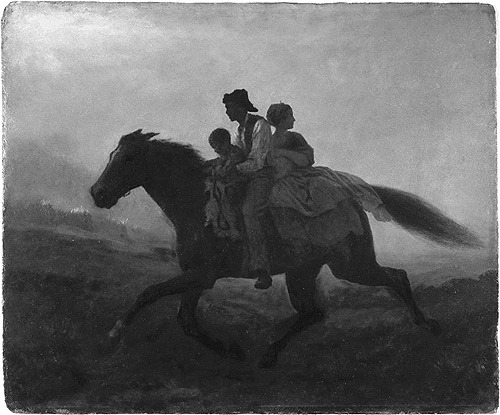
When I lay down to sleep at night, the bed pillows are stacked at the base of a window in the north wall. I don a nightcap rather than draw the curtains. On clear nights, the last light I see before closing my eyes has traveled oh so far (124 and 79 light-years respectively*) through near empty space. Dubhe and Merak are the two stars in the Big Dipper known as 'the pointers' because an imaginary line extended through them leads directly to Polaris, the only star in the sky that doesn't seem to move. 150 years ago, runaway slaves knew these asterisms by another name and would follow the Drinking Gourd north to freedom. In the same way that all 'appearances became text' for Rigdzin Jigme Lingpa, the pointers are an astrophysical sign indicating the world's axis, the space beyond conception, the still point where awareness comes to rest each night, as well as for a moment during the interval after death and prior to the next rebirth.

The winter morning routine begins before dawn at the kitchen table where I share coffee with the ladies before they drive north, not to freedom but to man the trenches on the frontlines of samsara. Here they work as tax preparers and secretaries, serving a public that is too often rude, impatient, uneducated and under the illusion that they are dealing with government employees. Growing evidence of our failing economy appears in the form of customers crowding the office seeking advances on their returns in spite of the 35% interest the banks are charging. Beyond the stress of dealing with the public, down servers and poorly designed software, misunderstandings and disagreements with friends and co-workers can make this time of year a real test of patience and joyful effort for all of us. More evidence of the big squeeze came a few days ago when a twelve mile section of divided highway which had been posted at 65 mph for years was suddenly changed to 55. Thousands of people, many with marginal factory and service industry incomes drive this stretch everyday and have become habituated to the speed as the road was originally constructed as a way to bypass the town. The cops are having a field day preying on the overworked and underpaid.

This situation finds me in the kitchen once again around sundown to jam with the kids at putting together something that will pass for dinner. Our culinary skills are humble but gradually evolving. My last stint as a cook took place over twenty years ago when we lived in Jamaica and Tenkar was pregnant with Isa, our fourth child. Truth be told, I haven't had much practice since then but so far, so good. Isa, Kyema and I have a great time putting our limited talents and knowledge together to prepare something we can all appreciate. Our 'beginner's mind' usually manages to provide a measure of creative variety in spite of the simplicity of the fare. Our specialties are rice and vegies with 'secret' miso sauce, tortillas with fixings, bean soups and pasta.

Long after dark headlights wind their way up the drive,and dakinis emerge out of the darkness greeted by the barking of dogs. Depending on scheduling, they might arrive home together or alone but in any case we immediately head for the comfort of the woodstove to share stories of the days trials and trivia before sitting down with plates of hot food, often followed by a cup of tea and only a few precious hours to share before retiring. This is not the time for anything very demanding. Herb, foot-rubs, some talk of current events; they often do not have the energy to stay awake through an entire movie. This is how it goes during the peak period of tax season.

*****

F
or whereas the mind works in possibilities, the intuitions work in actualities, and what you intuitively desire, that is possible to you. Whereas what you mentally or "consciously" desire is nine times out of ten impossible; hitch your wagon to a star, or you will just stay where you are.
D.H. Lawrence (1885-1930)


The years in which the light presently perceived was generated by these two distant suns happen to frame the birth [Dubhe] and death [Merak] years of Mr. Lawrence's brief time on earth.

Thursday, January 01, 2009

Minor Hill


We spent a few hours visiting with Dechen's granny Betty Lou in a small white cottage on Minor Hill, a little community about 25 miles to the south and about as far from the Alabama border. On the way, I notice massive white pillars holding up new sections of widened roadways snaking from side to side through these green valleys. In the spirit of true pork-barrel spending, it seems every two-lane blacktop in the state is being expanded into quasi-interstate highways, regardless of local needs.

Dechen, Tenkar and I will be the only guests for dinner this afternoon. Betty Lou lives with her son Joe who was absent, house-sitting for a friend. Years ago, Granny lost her elder son to suicide and a daughter in a car accident. Dechen's mother is Betty Lou's child but refuses to visit or even return her calls on the basis of clinging to some old painful karmas that nobody understands very well. Betty Lou seems resigned to this sad state of affairs with a measure of understanding and surprisingly, no bitterness.

The kitchen is narrow and we immediately sit down to a spread of iced tea, pinto beans, green beans, corn bread, creamed corn, macaroni and mashed potatoes. She apologizes for the age and wear of the chairs, laughs about spilling the black pepper and having to rinse it out of the the macaroni and underscores how Joe loves potatoes; he virtually survives on them. We dine on fine English china produced by a certain Churchill which is usually kept in a glass cabinet made by Betty Lou's brother who has since sold all his tools. A fading color photo of Dechen as a child hangs on blond paneling bordered by two candles like a small shrine. Names of relatives dead and alive dominate the conversations. Granny compliments Tenkar on her necklace and after a closer inspection, Tenkar offers to make her one just like it. Dechen shares photos from the Grand Canyon and her sister's wedding. She mentions email and Granny says that they recently dropped their internet connection because of the monthly fee although Joe still uses the computer to store digital photos. In the background, the satellite radio station on the television plays easy-listening versions of old hits that my mother would like and chocolate pie is served.

After the meal, Granny begins going through boxes of things in the living room. She has decided to give away the Christmas dishes because 'us getting together on the holidays seems to be a thing of the past'. Chet Atkins picks out the melody line of a Carpenter's song against a background of strings. When Dechen asked about her taste in movies, Granny said she liked Gregory Peck but never cared for Cary Grant or Liz Taylor. I begin to doze on the couch, the ladies giggled and I decide to step outside to get some air and catch some of the year's last twilight. I sit on the backyard grass, recognizing our location on a ridge as tree tops stretch to the horizons under clear skies. I breathe easy and say dakini mantra while observing the display of forms and colors around me. Few cars pass. People out this way don't have any money to speak of but nobody goes hungry. Whatever there is of real poverty out here is in our heads and hearts.

Sunday, December 21, 2008

Sun Temple

Happy Solstice

These last ten days of the year serve as a non-secular retreat for most of the western world. Not much of a contemplative retreat but for many, a certain anticipation of leisure and good food. Nuts will be cracked! Blogs and media retrospectives will summarize the year in politics and entertainment, obituaries, sports, the best and worst of '08' lists are hurriedly being composed. And that ain't all...

Amongst my friends, there are impoverished buddhists who invest way more time, money and energy in celebrating Christmas than they do in any Buddhist holiday. Ask and they will say they do it for their kids or grandkids, (who are neither Christian nor being raised Christian). When I consider this kind of situation, it seems redolent with suffering. Having failed to create/discover an alternative means of expression, people resignedly conform and initiate the young into the mindless rituals of consumerist culture, encouraging cycles of expectation and disapointment in relation to the year's 'take'.

From where i sit, the midday sun streams thru the highest branches of the tulip magnolia in the yard, throwing a broken shadow on some of the plants clustered at the base of the glass door. It will only be like this for a few more days as the arc begins ascending higher into the sky. If you think of it, pull back the curtains and note the westernmost place where the last direct rays of sun strike a wall in your home before sunset tonight. Mark it! If the sky is clear, you should be able to do this unless your apartment faces east or north. To complete the mission, do it again on an equinox and the summer solstice. Now you live in a sun temple.

Last night we were talking about how it is increasingly common for us to consider the nature of the food we eat, means of production, cost, how it is prepared and the quality of the environment wherein it is consumed. That's a big source of our energy but by no means the only one. So as we move into this period, remember the supreme gifts of appreciation, consecrated presence, simple mindfulness, conscious breathing, relaxed alertness, good humor, good company to y'all...

Friday, December 19, 2008

Trust

We rarely lock our doors. Years ago, when we first moved here, our only neighbors were two brothers, local boys and their wives, occupying separate trailers. One of their little girls would remove any prayer flags she came across in the woods or by our spring. We simply replaced them. The child's grandmother was equally curious and quietly climbed the hill behind us to see what the hippies do up there and discovered what she called 'kung-fu altars' which was apparently a relief as there were rumours about 'devil-altars'. Good woman that she is, Christine checked the hill out our for herself and assured her friends that whatever it was that we were doing, it was definitely not demonic. Eventually, their little clan moved away and sold the land to other members of our sangha.

An assortment of crystals and stones, some carved into the shape of turtles, dorjes, bells, sea shells and antlers, conchs, and buddha statues cover these little shrines and beyond changing a worn cloth or adding a new offering, they have sat undisturbed for decades.

My closest neighbors are friends who bought some of the land next door. They live another quarter mile into the woods where the road comes to a dead end. We often make use of this stretch for short afternoon walks. They had attended a Christmas recital at the local school where their kids performed Mozart's Night Music and came home to find their house had been robbed. We are pretty sure we know who did it. It is pretty quiet back here. Sometime in the afternoon, a car sped up the road so fast that the noise got my son's attention, allowing him to identify the vehicle through the now bare woods. The police were called. Everything is replaceable except the trust.

Wednesday, December 10, 2008

December Twilight

Returning from a late afternoon walk we stopped to look at the sky in the west. Above the hills, luminosity pouring through a network of bare trees like stained glass, a few dense clouds hovering in the upper branches of the hickories glow fiery orange, soon burnishing an intense bronze before cooling to purple. Padmasambhava's Copper-Colored Mountain is said to be somewhere in that range of light to the southwest.

One day the three masters decided to have a horse race and see who would win. Chokgyur Lingpa, on a dappled horse, came first, followed by Jamyang Khyentse on a dark blue horse. Kongtrul finished last and arrived crying like a child. “I am so unfortunate,” he wailed. Some people said, “Jamgon Kongtrul is usually a great lama, but he weeps when he loses a horse race.” Others said it was because he was the oldest. The real reason was they were seeing who would first reach the Copper-Colored Mountain.

-from The Life of Chokgyur Lingpa as spoken by Orgyen Tobgyal Rinpoche

Thursday, May 01, 2008

The Western Quarter


There is a wooded hill directly behind my house occupying about twenty acres and rising a hundred feet or so above the valley floor. The slopes are covered in trees. Three paths lead to the top; one on the north, one on the south and one on the east. The center of the hill is grassy, open and park-like. To have access to such a place, which is bigger than many urban parks and far more secluded is a good dream. I moved here to get my family out of the crowded, spiritually sterile and criminally overpriced suburbs of New England. Nineteen years ago, after having lived on this land for a year, my sons helped me begin tracing a circular path through the woods around the crown of the hill. At first they just followed me as we shuffled our feet and kicked leaves out of the way. Then we raked and set up rough little altars that were generally oriented in the cardinal directions and sat a little metal Buddha statue on each one.

Four years later, after a lightning bolt struck the northern altar and burnt it to the ground, my good neighbor Rigdzin replaced the old stumps with a simple slab of sweet cedar laid across cedar posts. The ladies sewed altar cloths in bright solid colors, one for each of the four directions. These cover the wood and are replaced about once a year. Gradually, each altar was outfitted with an incense burner, a bell and dorje, prayer flags, a conch, flowers, a turtle shell, a bench and many other offerings.

According to the Vajrayana mandala, spring is associated with twilight and the western direction so today I sat on the bench before the fire altar at sundown. Two tall oaks, one red and one white, frame the seat. A small mossy circle around the altar and bench has been raked free of leaves, but we are in the woods. A fair mixture of oak, hickory, poplar, and tupelo with white flowering dogwoods illuminating the understory. The land falls steeply away into a dark valley toward the creek before quickly rising again. Another heavily wooded hill of the same height rises a few hundred yards to the west with trees so tall that even here on the crest of the hill, I feel as if I am still in a valley; the density of the wood and spring foliage conspire to raise the horizon so that everyday fewer beads of orange solar fire bleed through the new growth.

The bench I sit upon features a large blood red triangle bordered by a two small disks, one red and one white, symbolizing sun and moon. The western altar is associated with the element of heat and illumination, so the fading cloth and tattered prayer flags between the trees are all shades of red. Amitabha, the Buddha of Infinite Light holds a bowl of immortality nectar and Guru Padmasambhava sits before him, brandishing a dorje vertically before his chest, the Diamond Axis which does not change or die. A chubby Hwa Shang lounges and laughs.

Offerings include two perfect flint arrowheads possibly fashioned by Chickasaw hunters discovered in local fields which echo the triangle shape. A shiney black core of obsidian from the highlands of Guatemala , a dense igneous stone from the top of a 13,000 foot volcano, lava rocks from New Mexico, sandstone from Canyonlands in Utah, a delicate conch with a good sharp tone from the Gulf of Mexico, a clear finger of crystal emerging from a fist of white quartz with a few smooth red stones from the Colorado Rockies, various shells, beads and many crystals.

This is the dimension of the lotus, the blessings of the ever youthful Padmasambhava, who along with Great Silent Shakyamuni, is considered an earthly manifestation (nirmanakaya) of Amitabha. According to Indo-Tibetan lore, the natural beauty of the peacock's tail is a result of her ability to consume poisons. During this dusk of transition from cold of longest night to heat of longest day, things are seen in an ever new light. The heat and energy of desire is transformed into discriminating awareness wisdom. The true nature of perception is revealed as infinite light.

********

Along with the Mahayanist expansion of the buddhist sangha to include layman in the common era, there also evolved an arsenal of upaya (skilfull means) including the use of celestial bodhisattavas such as Avalokitesvara as a devotional focus. The tantric cartography of these principles gave rise to the double-dorje mandala associated with the peaceful deities of the heart center.

One of the earliest forms of such devotional worship and focus in Buddhism was the cult of Amitabha. The Buddha of Infinite Light and his retinue occupy the western quarter of the mandala. Some aspects of Amitabha's qualities may have originated in Iran where prior to the time of the Buddha, the Zoroastrians had developed the HOMA ritual. A sacred barbecue was combined with the use of a vegetable intoxicant. With the coming of the teacher Zarathustra, the use of the sacrament was criticized and associated with moral excesses. His popularity and the politics of the day led to abandoning the psycho-actives at least at public gatherings, but they kept the barbecue ritual central. The energy of the teacher's physical presence and spiritual influence around a communal meal was to replace what in some circles, had degenerated into the obscuring stupor of mundane intoxication. The terms homa and the soma (of the rishis), are cognate.

If not earlier, the Zoroastrian strain of the fire puja practice eventually migrated across the Hindu-Kush with the Parsis around the same time that Padmasambhava was visiting Tibet. It is likely that both he and they were fleeing Islamic oppression. India has had contact with 'lands beyond the Indus' since the times of the Mahabharata (5th c. BCE) and fire rituals were old hat, and were even performed by Brahman priests at the time of Sakyamuni. The Buddha taught his listeners the inner meaning of such ancient practices and openly criticized the superstitious, corrupt and spiritually inefficient rites of the old tradition and the caste system in which it operated.

The Western Pureland tradition blossomed on China's Mount Lushan in 402 and the mantra of Avalokitesvara, a bodhisattva in Amitabha's retinue, was chanted by the Tibetan King, fifty years before Padmasambhava came to Tibet Over the centuries since the Buddha's passing, various sacred forms had evolved to help practitioners recall the teachings and to invoke the spiritual presence of the teacher. But it seems that the actual practice of buddhist fire pujas began after Padmasambhava began working on the construction of Samye, the first monastery in Tibet. Originally, it was the smoke from burnt offerings which carried the essences to the host. The fire puja was intended to pacify demons both internal and external, obstructing worthy efforts. Padmasambhava had very likely been exposed to both Zoroastrian and Manichaean (with its legions of devils) teachings in his homeland and possibly adapted elements from indigenous Bon shamans as well.

An interesting note on the possible geographic location of Oddiyana, long assumed to be in the Swat Valley of Pakistan, although supportive archaeological evidence does not yet exist;
According to the late H.V. Guenther in Wholeness Lost, Wholeness Regained, "There is no evidence for either Alexander Cunningham's or Giuseppe Tucci's identification of Uddiyana with the Swat Valley in Pakistan. On the contrary, all the evidence points to Central Asia south of the Aral Sea. What they overlook or deliberately ignore is the unanimously accepted tradition of Padmasambhava's birthplace being associated with a lake and the overwhelming frequency of the ending, -ana in Central Asian place names, for instance, Sogdhiana, Drangiana, Ferghana, and so on, and even the name Urgensch (see Edgar Knobloch, Beyond the Oxus, p. 73). It therefore seems to be more reasonable to connect his birthplace with Sogdhiana, situated around Lake Aral, and to take note of the fact that the Sogdhians were highly educated people whose religion "was a synthesis of many creeds and currents, incorporating elements of Zoroastrianism, Manichaeism, Buddhism, and Christianity, together with Greek and Indian mythology. Trade with China was entirely in their hands and their outposts and settlements were scattered practically all over Chinese Turkestan" (Edgar Knobloch, Beyond the Oxus, p. 54). This synthesis, if not so say, syncretism is quite evident in Padmasambhava's own writings. It is more than likely that, when the Sogdhian civilization was crushed by the Arabs, he came as a "refugee" to Tibet and, in order to protect his relatives, who were left behind, declared himself to have neither a father nor a mother.


Friday, April 18, 2008

Mississippian Era Mud


The earth is still very alive. Early this morning slipping outside and pissing in the overgrown grass before spreading a cup of bird seed on the little wooden platform. Mowing late this year and offering free brunch has attracted more birds than usual. A Rose-breasted Grosbeak couple has recently nested in the neighborhood. I came back inside, turned on the 'puter when Dechen leaned over the railing above and asked if I'd felt the earthquake. Really? I hadn't felt a thing. She awoke at 4:37 a.m. with the bed shaking, the rod iron design on the wall above her pillow rattling. She wondered if the roof was going to blow off from a low pressure cell, (not an uncommon feeling around here) and then realized it wasn’t a storm at all, maybe density waves from helicopter blades? Recognition that the entire house was moving gave rise to a transcendent sense of place. She was feeling the release of great pressures deep in the earth's crust in a fault zone associated with the New Madrid earthquakes of 1812. Turtle Hill rises about 200 miles SSE from the epicenter 7.2 miles below the Wabash Valley of southeastern Illinois, but the shift woke her up. Tenkar felt it too, thought it a hellacious wind and drifted back to sleep. A harmless earthquake is a bit like a good entheogenic opening; a powerful reminder that things are not as solid or permanent as they may appear.

I was fast asleep for this one and have not experienced a good temblor for nearly thirty years. We were living in the hills above Lake Atitlan in Guatemala experimenting with soybeans and amaranth. In nearby Nicaragua, Sandinista Rebels had recently deposed the intolerably corrupt second generation dictator Anastasio Somoza. An electric surge of emotion accompanied this news as it spread through the highlands with the poor in good humor and the rich sweating new fear. The ongoing civil conflict in Guatemala was about to enter its most violent years. Tenkar was pregnant with Zoe, our third child. I was digging a hole for an outhouse. Progress stalled in the subsoil, where a layer of highly compressed volcanic clay required an initial breakup and loosening with a pick before filling buckets with chunks of tal-petate to deepen the hole. I was on my knees in the rubble a few feet below ground level, filling a tin when a wave passed which seemed to turn the ground to jelly beneath me, lifting and dropping one knee and then the other as the earth rippled like a snake and folks came tearing out of the main house hollering.

As the unquestioned abstraction of a solid earth persists in spite of the occasional quake or gamma ray blast, mind tends to casually equate a reality and stability to objects they do not possess. Basking in the seeming permanence of life, paying easy homage to idols of worldly happiness and counterfeit spirituality, the worship of fabrications, the fruit clinging to a seed of assumed existence; the separate self located within the infinite multiplicity of a world machine. We do not refer to real objects but deal in psychic artifacts, relative classifications of phenomena, manufactured according to user needs with no real borders; adopted and abandoned at will. Mind looks to relations and things, rituals of seeking through knowldege, friendships and possessions -- for keys and fulfillment, clinging to familiar forms and habits, reference points to continually recreate and identify a center of control, to re-affirm a sense of self-existence.

Inseparable from all of that, Mayapple groves simply appear on the lower slopes of Resistance Ridge and tulip poplars climb straight up toward the clouds. An old bearded friend who favors a beret lives up top, his movement and conversation hidden behind a thick grove of dark green bamboo. It is the same way on this side. This great hillside mass of organic silence and resistance between us offers vision and privacy and most years, hosts the play of barred owls.


Dechen, Tenkar and I walked further up into the hollow this afternoon, past magnolia, down the road below unimaginably pink redbuds afloat in the understory, an intensity long natural to this forested place, nameless hollow in these low hills of southern Tennessee. The gray gravel path runs beside a thick mat of watercress thriving in a spring called virtue. Further up red road identifying leafless trees by bark alone hackberry, sycamore, sweet gum, cherry and beech growing down out of small islands in multi-braided creek. The path leads around the biggest white oak on the land curving upon a ledge, creamy narcissus looking civilized among old foundation stones where the blacksmith's family settled long ago. Small pale yellow-green flowering dogwoods tweaked contrast under overcast skies at catkin time, a thousand baby junipers showing promise, chickweed, purple phlox and coils of fiddleheads laughing on mossy paths with a dozen other kinds of wildflowers blooming everywhere through the woods transforming clear light above into multi-color life below before the canopy mosaic fills in warm green summer shadows. A lizard scampers up a drain pipe and two black snakes, one coiled with head lifted and tongue flickering in bamboo, another gliding across dry leaves as we pass through a scattering of deer bones. "A charnel ground," I mutter as satin gray slithers off into a brush pile.

Descending out of the woods toward the soft dirt around the edge of the pond we come upon plenty of deer tracks. As beautiful and attractive as such open places can be, the water hole is notoriously dangerous. Nobody but human beings and their dogs drink at ease here. Dechen calls me over to look at a large footprint and what certainly appear to be bobcat tracks. They usually walk with their claws retracted so this one must have been on the move. First time I've seen those in these parts. I’ll bet I know what he had for dinner.


Bobcat track next to deer hoof print in soft Mississippian era mud (shot by Tenkar). According to Wiki, "The Bobcat's range does not seem to be limited by human populations, as long as it can still find a suitable habitat; only large, intensively cultivated tracts are unsuitable for the species. The animal may appear in backyards in "urban edge" environments, where human development intersects with natural habitats."

Saturday, April 12, 2008

Aggregates


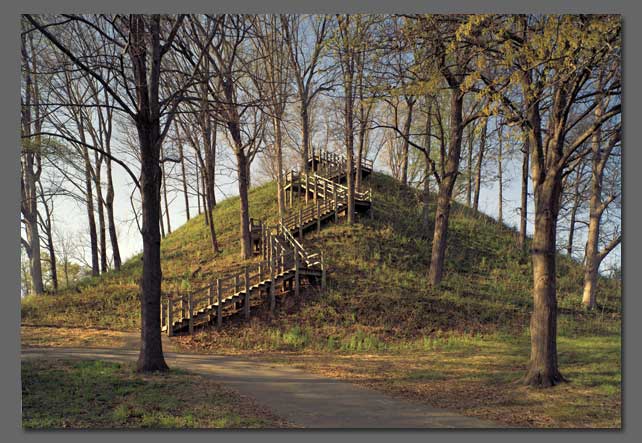
The largest Middle Woodland Period (200 bce - 400 ce) archaeological site in the Southeast. Twelve mounds, a geometric earthen enclosure, and ritual activity areas cover four hundred acres. Five large rectangular platform mounds (ranging in height from 7 to 72 feet) of Middle Woodland age underscores the unique nature of the Pinson Mounds site.

A tornado hit Lawrence county yesterday morning, passing about ten miles south of our house. With cloud tops above 45,000 feet high winds approaching from the southwest destroyed four homes and damaged at least 100 more. Five people were injured but fortunately, nobody was killed. That makes 16 tornadoes touching down in our county in the past 18 years (1990-2008).

Memucan Hunt Howard, (1807-1856) expressed a familiar assumption about the lack of indigenous settlements in this part of the country. "I have heard it said that the Indians, when asked why none of them lived in West Tennessee, replied that it leaked too much. For a time, after I first went there I thought it rained, hailed, thundered and lightened with more wind than I had known elsewhere."

At 14 years old, Howard was working as a surveyor in the woods of western Tennessee when his crew came across evidence of 'the one's who came before'. Howard describes the scene of the discovery. "Each party had a trumpet or horn by which we could generally find each other and the packmen, the more readily - The Trumpets were carried at our backs to prevent it from interfering with the with the compass needle. On emerging from the swamp of the middle fork of the Forked Deer River, about a dozen miles above Jackson when going south-to high land we came to a large bold spring of water and camped between it & a mound some six or seven feet high, and extensive enough for Houses & a small yard, and a large body of beautiful rich level heavy timbered land adjacent to it, with which Pinson was so much pleased that some one of the Company proposed to call it Mount Pinson; we did not see or know of the large Mounds two or three miles further South for months afterward, (...) I saw the large mound a year or two later supposed it to be about 70 or 75 feet high, and was nearly four hundred yards in circumference-near it was a square Mound (I think it was square) about twenty feet high smaller Mounds dikes etc. abounded thereabouts."

These earthworks are some of the oldest evidence of human communities in North America. The park where they are located is often empty and silent,
a good support for walking meditation best visited between autumn and early spring while the forms of the hills are revealed and the bugs are dormant. Like the monolith in 2001, the mounds present an existential gravitas that plunges the mind into a deeper consideration of our evolutionary origins and cultural patterns. Sir Arthur C. Clarke who passed away last winter gave the monolith the same ratios as the UN Building on the East River in Manhattan. On the most basic level, such consecrated mass evokes a sense of the inherent order of the universe including the ability and obligation to come together and conduct this energy in a pure way. The ultimate artifact has been communicated in various ways throughout history, but beyond all drama and formal expression lies the primary mandala of contelligence, the truth of interdependence. Earthen altars invite participation in the great process of cosmic alchemy, bringing together elements both sentient and non-sentient, bridging past and future, spontaneously harmonizing the aggregates, as loving friends, couples, families, communities, and natural systems in expressing what is already whole by nature.

Built up by manual labor, one basketful of dirt at a time, the mounds contain burials and like major complexes in Mexico and Guatemala, reflect an awareness of astronomical patterns framing yearly agricultural and ritual events. Pyramids, medieval cathedrals, stupas and sun temples the mounds embody subtle signatures of the essential, unchanging reality of radiant being at the heart of all change, an invocation of the sacred nature of space and time, the non-duality of life and death, bridging the world above with the one below.
Tikal, Guatemala

Some Native Americans are requesting that the mounds be returned to their original state, free of trees. Tom Kunesh, activist and founding member of the Advisory Council on Indian Affairs (ACTIA) writes, "Mounds are the single most enduring physical legacy of Native American people who lived in what we now call Tennessee. When they were created the people were reminded daily of their passed relatives and leaders and their relationship to the earth and sun. In the past they were kept clean and visited. Now new gods, both foreign and domestic, have replaced the old ones, and the mounds are covered in trees, testimony to their religious and cultural insignificance, proof of the atheism of their descendants."


Pinson Mound, TN