Friday, February 13, 2009

The Bottom


This year we are getting an early start on the garden. Ian mans the one row plow like those used by our Amish neighbors. In place of horses and the absence of tractor, Dave guns the Ranger and pulls the steel blade through some of the darkest soil in this part of Tennessee(900+ ft. above sea level).

Happy Trails


Son Isa and I walked into the nursing home last week and were immediately hit with the acrid smell of piss. We said nothing, actually expected it and walked straight to the desk where a girl asked who we wanted to see. "William Dowling" She recognized my face from photos that Mr. Dowling had on his wall and gave us the room number before pointing us down a hallway. I made eye-contact with a few of the patients sitting in wheelchairs along the way. Most of them did not acknowledge any exchange. Bill was sitting up, watching television. He immediately shut it off and we all hugged.

Once upon a time, Bill was a hard-drinking truck driver in New England and had apparently pissed off his family so bad that none of them wanted anything to do with him anymore. He still felt strong and big around the shoulders, even after six operations for cancer. His eyes welled up as he spoke, "Man, it is good to see you guys again. It gets pretty lonely in here."

"Yeah, I'll bet it does."

His roommate entered in a wheelchair. He was one of those in the hallway who had not responded but now asked Isa to open the door to the bathroom for him. To show us that he was not totally defeated but was dealing with his situation like the man he is, Bill said, "They just made me a greeter, so I'll have something to do around here now." Even more significant, a woman on the other end of the building had recently gifted him with one of those battery powered chairs to get around in and he was happy about that. After about 15 minutes, we walked out of there vowing to visit again soon.

This morning we learned that Bill passed away last night.

Happy trails old friend.

Wednesday, February 04, 2009

Tax Season


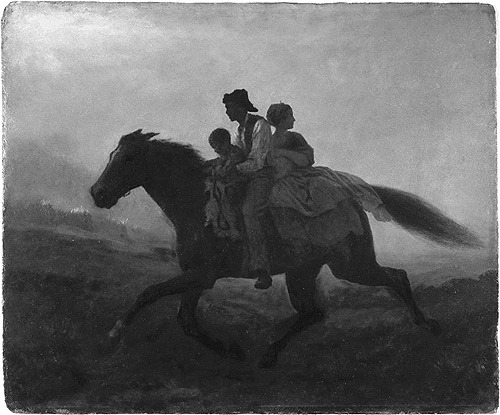
When I lay down to sleep at night, the bed pillows are stacked at the base of a window in the north wall. I don a nightcap rather than draw the curtains. On clear nights, the last light I see before closing my eyes has traveled oh so far (124 and 79 light-years respectively*) through near empty space. Dubhe and Merak are the two stars in the Big Dipper known as 'the pointers' because an imaginary line extended through them leads directly to Polaris, the only star in the sky that doesn't seem to move. 150 years ago, runaway slaves knew these asterisms by another name and would follow the Drinking Gourd north to freedom. In the same way that all 'appearances became text' for Rigdzin Jigme Lingpa, the pointers are an astrophysical sign indicating the world's axis, the space beyond conception, the still point where awareness comes to rest each night, as well as for a moment during the interval after death and prior to the next rebirth.

The winter morning routine begins before dawn at the kitchen table where I share coffee with the ladies before they drive north, not to freedom but to man the trenches on the frontlines of samsara. Here they work as tax preparers and secretaries, serving a public that is too often rude, impatient, uneducated and under the illusion that they are dealing with government employees. Growing evidence of our failing economy appears in the form of customers crowding the office seeking advances on their returns in spite of the 35% interest the banks are charging. Beyond the stress of dealing with the public, down servers and poorly designed software, misunderstandings and disagreements with friends and co-workers can make this time of year a real test of patience and joyful effort for all of us. More evidence of the big squeeze came a few days ago when a twelve mile section of divided highway which had been posted at 65 mph for years was suddenly changed to 55. Thousands of people, many with marginal factory and service industry incomes drive this stretch everyday and have become habituated to the speed as the road was originally constructed as a way to bypass the town. The cops are having a field day preying on the overworked and underpaid.

This situation finds me in the kitchen once again around sundown to jam with the kids at putting together something that will pass for dinner. Our culinary skills are humble but gradually evolving. My last stint as a cook took place over twenty years ago when we lived in Jamaica and Tenkar was pregnant with Isa, our fourth child. Truth be told, I haven't had much practice since then but so far, so good. Isa, Kyema and I have a great time putting our limited talents and knowledge together to prepare something we can all appreciate. Our 'beginner's mind' usually manages to provide a measure of creative variety in spite of the simplicity of the fare. Our specialties are rice and vegies with 'secret' miso sauce, tortillas with fixings, bean soups and pasta.

Long after dark headlights wind their way up the drive,and dakinis emerge out of the darkness greeted by the barking of dogs. Depending on scheduling, they might arrive home together or alone but in any case we immediately head for the comfort of the woodstove to share stories of the days trials and trivia before sitting down with plates of hot food, often followed by a cup of tea and only a few precious hours to share before retiring. This is not the time for anything very demanding. Herb, foot-rubs, some talk of current events; they often do not have the energy to stay awake through an entire movie. This is how it goes during the peak period of tax season.

*****

F
or whereas the mind works in possibilities, the intuitions work in actualities, and what you intuitively desire, that is possible to you. Whereas what you mentally or "consciously" desire is nine times out of ten impossible; hitch your wagon to a star, or you will just stay where you are.
D.H. Lawrence (1885-1930)


The years in which the light presently perceived was generated by these two distant suns happen to frame the birth [Dubhe] and death [Merak] years of Mr. Lawrence's brief time on earth.

Thursday, January 01, 2009

Minor Hill


We spent a few hours visiting with Dechen's granny Betty Lou in a small white cottage on Minor Hill, a little community about 25 miles to the south and about as far from the Alabama border. On the way, I notice massive white pillars holding up new sections of widened roadways snaking from side to side through these green valleys. In the spirit of true pork-barrel spending, it seems every two-lane blacktop in the state is being expanded into quasi-interstate highways, regardless of local needs.

Dechen, Tenkar and I will be the only guests for dinner this afternoon. Betty Lou lives with her son Joe who was absent, house-sitting for a friend. Years ago, Granny lost her elder son to suicide and a daughter in a car accident. Dechen's mother is Betty Lou's child but refuses to visit or even return her calls on the basis of clinging to some old painful karmas that nobody understands very well. Betty Lou seems resigned to this sad state of affairs with a measure of understanding and surprisingly, no bitterness.

The kitchen is narrow and we immediately sit down to a spread of iced tea, pinto beans, green beans, corn bread, creamed corn, macaroni and mashed potatoes. She apologizes for the age and wear of the chairs, laughs about spilling the black pepper and having to rinse it out of the the macaroni and underscores how Joe loves potatoes; he virtually survives on them. We dine on fine English china produced by a certain Churchill which is usually kept in a glass cabinet made by Betty Lou's brother who has since sold all his tools. A fading color photo of Dechen as a child hangs on blond paneling bordered by two candles like a small shrine. Names of relatives dead and alive dominate the conversations. Granny compliments Tenkar on her necklace and after a closer inspection, Tenkar offers to make her one just like it. Dechen shares photos from the Grand Canyon and her sister's wedding. She mentions email and Granny says that they recently dropped their internet connection because of the monthly fee although Joe still uses the computer to store digital photos. In the background, the satellite radio station on the television plays easy-listening versions of old hits that my mother would like and chocolate pie is served.

After the meal, Granny begins going through boxes of things in the living room. She has decided to give away the Christmas dishes because 'us getting together on the holidays seems to be a thing of the past'. Chet Atkins picks out the melody line of a Carpenter's song against a background of strings. When Dechen asked about her taste in movies, Granny said she liked Gregory Peck but never cared for Cary Grant or Liz Taylor. I begin to doze on the couch, the ladies giggled and I decide to step outside to get some air and catch some of the year's last twilight. I sit on the backyard grass, recognizing our location on a ridge as tree tops stretch to the horizons under clear skies. I breathe easy and say dakini mantra while observing the display of forms and colors around me. Few cars pass. People out this way don't have any money to speak of but nobody goes hungry. Whatever there is of real poverty out here is in our heads and hearts.

Sunday, December 21, 2008

Sun Temple

Happy Solstice

These last ten days of the year serve as a non-secular retreat for most of the western world. Not much of a contemplative retreat but for many, a certain anticipation of leisure and good food. Nuts will be cracked! Blogs and media retrospectives will summarize the year in politics and entertainment, obituaries, sports, the best and worst of '08' lists are hurriedly being composed. And that ain't all...

Amongst my friends, there are impoverished buddhists who invest way more time, money and energy in celebrating Christmas than they do in any Buddhist holiday. Ask and they will say they do it for their kids or grandkids, (who are neither Christian nor being raised Christian). When I consider this kind of situation, it seems redolent with suffering. Having failed to create/discover an alternative means of expression, people resignedly conform and initiate the young into the mindless rituals of consumerist culture, encouraging cycles of expectation and disapointment in relation to the year's 'take'.

From where i sit, the midday sun streams thru the highest branches of the tulip magnolia in the yard, throwing a broken shadow on some of the plants clustered at the base of the glass door. It will only be like this for a few more days as the arc begins ascending higher into the sky. If you think of it, pull back the curtains and note the westernmost place where the last direct rays of sun strike a wall in your home before sunset tonight. Mark it! If the sky is clear, you should be able to do this unless your apartment faces east or north. To complete the mission, do it again on an equinox and the summer solstice. Now you live in a sun temple.

Last night we were talking about how it is increasingly common for us to consider the nature of the food we eat, means of production, cost, how it is prepared and the quality of the environment wherein it is consumed. That's a big source of our energy but by no means the only one. So as we move into this period, remember the supreme gifts of appreciation, consecrated presence, simple mindfulness, conscious breathing, relaxed alertness, good humor, good company to y'all...

Friday, December 19, 2008

Trust

We rarely lock our doors. Years ago, when we first moved here, our only neighbors were two brothers, local boys and their wives, occupying separate trailers. One of their little girls would remove any prayer flags she came across in the woods or by our spring. We simply replaced them. The child's grandmother was equally curious and quietly climbed the hill behind us to see what the hippies do up there and discovered what she called 'kung-fu altars' which was apparently a relief as there were rumours about 'devil-altars'. Good woman that she is, Christine checked the hill out our for herself and assured her friends that whatever it was that we were doing, it was definitely not demonic. Eventually, their little clan moved away and sold the land to other members of our sangha.

An assortment of crystals and stones, some carved into the shape of turtles, dorjes, bells, sea shells and antlers, conchs, and buddha statues cover these little shrines and beyond changing a worn cloth or adding a new offering, they have sat undisturbed for decades.

My closest neighbors are friends who bought some of the land next door. They live another quarter mile into the woods where the road comes to a dead end. We often make use of this stretch for short afternoon walks. They had attended a Christmas recital at the local school where their kids performed Mozart's Night Music and came home to find their house had been robbed. We are pretty sure we know who did it. It is pretty quiet back here. Sometime in the afternoon, a car sped up the road so fast that the noise got my son's attention, allowing him to identify the vehicle through the now bare woods. The police were called. Everything is replaceable except the trust.

Wednesday, December 10, 2008

December Twilight

Returning from a late afternoon walk we stopped to look at the sky in the west. Above the hills, luminosity pouring through a network of bare trees like stained glass, a few dense clouds hovering in the upper branches of the hickories glow fiery orange, soon burnishing an intense bronze before cooling to purple. Padmasambhava's Copper-Colored Mountain is said to be somewhere in that range of light to the southwest.

One day the three masters decided to have a horse race and see who would win. Chokgyur Lingpa, on a dappled horse, came first, followed by Jamyang Khyentse on a dark blue horse. Kongtrul finished last and arrived crying like a child. “I am so unfortunate,” he wailed. Some people said, “Jamgon Kongtrul is usually a great lama, but he weeps when he loses a horse race.” Others said it was because he was the oldest. The real reason was they were seeing who would first reach the Copper-Colored Mountain.

-from The Life of Chokgyur Lingpa as spoken by Orgyen Tobgyal Rinpoche

Thursday, May 01, 2008

The Western Quarter


There is a wooded hill directly behind my house occupying about twenty acres and rising a hundred feet or so above the valley floor. The slopes are covered in trees. Three paths lead to the top; one on the north, one on the south and one on the east. The center of the hill is grassy, open and park-like. To have access to such a place, which is bigger than many urban parks and far more secluded is a good dream. I moved here to get my family out of the crowded, spiritually sterile and criminally overpriced suburbs of New England. Nineteen years ago, after having lived on this land for a year, my sons helped me begin tracing a circular path through the woods around the crown of the hill. At first they just followed me as we shuffled our feet and kicked leaves out of the way. Then we raked and set up rough little altars that were generally oriented in the cardinal directions and sat a little metal Buddha statue on each one.

Four years later, after a lightning bolt struck the northern altar and burnt it to the ground, my good neighbor Rigdzin replaced the old stumps with a simple slab of sweet cedar laid across cedar posts. The ladies sewed altar cloths in bright solid colors, one for each of the four directions. These cover the wood and are replaced about once a year. Gradually, each altar was outfitted with an incense burner, a bell and dorje, prayer flags, a conch, flowers, a turtle shell, a bench and many other offerings.

According to the Vajrayana mandala, spring is associated with twilight and the western direction so today I sat on the bench before the fire altar at sundown. Two tall oaks, one red and one white, frame the seat. A small mossy circle around the altar and bench has been raked free of leaves, but we are in the woods. A fair mixture of oak, hickory, poplar, and tupelo with white flowering dogwoods illuminating the understory. The land falls steeply away into a dark valley toward the creek before quickly rising again. Another heavily wooded hill of the same height rises a few hundred yards to the west with trees so tall that even here on the crest of the hill, I feel as if I am still in a valley; the density of the wood and spring foliage conspire to raise the horizon so that everyday fewer beads of orange solar fire bleed through the new growth.

The bench I sit upon features a large blood red triangle bordered by a two small disks, one red and one white, symbolizing sun and moon. The western altar is associated with the element of heat and illumination, so the fading cloth and tattered prayer flags between the trees are all shades of red. Amitabha, the Buddha of Infinite Light holds a bowl of immortality nectar and Guru Padmasambhava sits before him, brandishing a dorje vertically before his chest, the Diamond Axis which does not change or die. A chubby Hwa Shang lounges and laughs.

Offerings include two perfect flint arrowheads possibly fashioned by Chickasaw hunters discovered in local fields which echo the triangle shape. A shiney black core of obsidian from the highlands of Guatemala , a dense igneous stone from the top of a 13,000 foot volcano, lava rocks from New Mexico, sandstone from Canyonlands in Utah, a delicate conch with a good sharp tone from the Gulf of Mexico, a clear finger of crystal emerging from a fist of white quartz with a few smooth red stones from the Colorado Rockies, various shells, beads and many crystals.

This is the dimension of the lotus, the blessings of the ever youthful Padmasambhava, who along with Great Silent Shakyamuni, is considered an earthly manifestation (nirmanakaya) of Amitabha. According to Indo-Tibetan lore, the natural beauty of the peacock's tail is a result of her ability to consume poisons. During this dusk of transition from cold of longest night to heat of longest day, things are seen in an ever new light. The heat and energy of desire is transformed into discriminating awareness wisdom. The true nature of perception is revealed as infinite light.

********

Along with the Mahayanist expansion of the buddhist sangha to include layman in the common era, there also evolved an arsenal of upaya (skilfull means) including the use of celestial bodhisattavas such as Avalokitesvara as a devotional focus. The tantric cartography of these principles gave rise to the double-dorje mandala associated with the peaceful deities of the heart center.

One of the earliest forms of such devotional worship and focus in Buddhism was the cult of Amitabha. The Buddha of Infinite Light and his retinue occupy the western quarter of the mandala. Some aspects of Amitabha's qualities may have originated in Iran where prior to the time of the Buddha, the Zoroastrians had developed the HOMA ritual. A sacred barbecue was combined with the use of a vegetable intoxicant. With the coming of the teacher Zarathustra, the use of the sacrament was criticized and associated with moral excesses. His popularity and the politics of the day led to abandoning the psycho-actives at least at public gatherings, but they kept the barbecue ritual central. The energy of the teacher's physical presence and spiritual influence around a communal meal was to replace what in some circles, had degenerated into the obscuring stupor of mundane intoxication. The terms homa and the soma (of the rishis), are cognate.

If not earlier, the Zoroastrian strain of the fire puja practice eventually migrated across the Hindu-Kush with the Parsis around the same time that Padmasambhava was visiting Tibet. It is likely that both he and they were fleeing Islamic oppression. India has had contact with 'lands beyond the Indus' since the times of the Mahabharata (5th c. BCE) and fire rituals were old hat, and were even performed by Brahman priests at the time of Sakyamuni. The Buddha taught his listeners the inner meaning of such ancient practices and openly criticized the superstitious, corrupt and spiritually inefficient rites of the old tradition and the caste system in which it operated.

The Western Pureland tradition blossomed on China's Mount Lushan in 402 and the mantra of Avalokitesvara, a bodhisattva in Amitabha's retinue, was chanted by the Tibetan King, fifty years before Padmasambhava came to Tibet Over the centuries since the Buddha's passing, various sacred forms had evolved to help practitioners recall the teachings and to invoke the spiritual presence of the teacher. But it seems that the actual practice of buddhist fire pujas began after Padmasambhava began working on the construction of Samye, the first monastery in Tibet. Originally, it was the smoke from burnt offerings which carried the essences to the host. The fire puja was intended to pacify demons both internal and external, obstructing worthy efforts. Padmasambhava had very likely been exposed to both Zoroastrian and Manichaean (with its legions of devils) teachings in his homeland and possibly adapted elements from indigenous Bon shamans as well.

An interesting note on the possible geographic location of Oddiyana, long assumed to be in the Swat Valley of Pakistan, although supportive archaeological evidence does not yet exist;
According to the late H.V. Guenther in Wholeness Lost, Wholeness Regained, "There is no evidence for either Alexander Cunningham's or Giuseppe Tucci's identification of Uddiyana with the Swat Valley in Pakistan. On the contrary, all the evidence points to Central Asia south of the Aral Sea. What they overlook or deliberately ignore is the unanimously accepted tradition of Padmasambhava's birthplace being associated with a lake and the overwhelming frequency of the ending, -ana in Central Asian place names, for instance, Sogdhiana, Drangiana, Ferghana, and so on, and even the name Urgensch (see Edgar Knobloch, Beyond the Oxus, p. 73). It therefore seems to be more reasonable to connect his birthplace with Sogdhiana, situated around Lake Aral, and to take note of the fact that the Sogdhians were highly educated people whose religion "was a synthesis of many creeds and currents, incorporating elements of Zoroastrianism, Manichaeism, Buddhism, and Christianity, together with Greek and Indian mythology. Trade with China was entirely in their hands and their outposts and settlements were scattered practically all over Chinese Turkestan" (Edgar Knobloch, Beyond the Oxus, p. 54). This synthesis, if not so say, syncretism is quite evident in Padmasambhava's own writings. It is more than likely that, when the Sogdhian civilization was crushed by the Arabs, he came as a "refugee" to Tibet and, in order to protect his relatives, who were left behind, declared himself to have neither a father nor a mother.


Friday, April 18, 2008

Mississippian Era Mud


The earth is still very alive. Early this morning slipping outside and pissing in the overgrown grass before spreading a cup of bird seed on the little wooden platform. Mowing late this year and offering free brunch has attracted more birds than usual. A Rose-breasted Grosbeak couple has recently nested in the neighborhood. I came back inside, turned on the 'puter when Dechen leaned over the railing above and asked if I'd felt the earthquake. Really? I hadn't felt a thing. She awoke at 4:37 a.m. with the bed shaking, the rod iron design on the wall above her pillow rattling. She wondered if the roof was going to blow off from a low pressure cell, (not an uncommon feeling around here) and then realized it wasn’t a storm at all, maybe density waves from helicopter blades? Recognition that the entire house was moving gave rise to a transcendent sense of place. She was feeling the release of great pressures deep in the earth's crust in a fault zone associated with the New Madrid earthquakes of 1812. Turtle Hill rises about 200 miles SSE from the epicenter 7.2 miles below the Wabash Valley of southeastern Illinois, but the shift woke her up. Tenkar felt it too, thought it a hellacious wind and drifted back to sleep. A harmless earthquake is a bit like a good entheogenic opening; a powerful reminder that things are not as solid or permanent as they may appear.

I was fast asleep for this one and have not experienced a good temblor for nearly thirty years. We were living in the hills above Lake Atitlan in Guatemala experimenting with soybeans and amaranth. In nearby Nicaragua, Sandinista Rebels had recently deposed the intolerably corrupt second generation dictator Anastasio Somoza. An electric surge of emotion accompanied this news as it spread through the highlands with the poor in good humor and the rich sweating new fear. The ongoing civil conflict in Guatemala was about to enter its most violent years. Tenkar was pregnant with Zoe, our third child. I was digging a hole for an outhouse. Progress stalled in the subsoil, where a layer of highly compressed volcanic clay required an initial breakup and loosening with a pick before filling buckets with chunks of tal-petate to deepen the hole. I was on my knees in the rubble a few feet below ground level, filling a tin when a wave passed which seemed to turn the ground to jelly beneath me, lifting and dropping one knee and then the other as the earth rippled like a snake and folks came tearing out of the main house hollering.

As the unquestioned abstraction of a solid earth persists in spite of the occasional quake or gamma ray blast, mind tends to casually equate a reality and stability to objects they do not possess. Basking in the seeming permanence of life, paying easy homage to idols of worldly happiness and counterfeit spirituality, the worship of fabrications, the fruit clinging to a seed of assumed existence; the separate self located within the infinite multiplicity of a world machine. We do not refer to real objects but deal in psychic artifacts, relative classifications of phenomena, manufactured according to user needs with no real borders; adopted and abandoned at will. Mind looks to relations and things, rituals of seeking through knowldege, friendships and possessions -- for keys and fulfillment, clinging to familiar forms and habits, reference points to continually recreate and identify a center of control, to re-affirm a sense of self-existence.

Inseparable from all of that, Mayapple groves simply appear on the lower slopes of Resistance Ridge and tulip poplars climb straight up toward the clouds. An old bearded friend who favors a beret lives up top, his movement and conversation hidden behind a thick grove of dark green bamboo. It is the same way on this side. This great hillside mass of organic silence and resistance between us offers vision and privacy and most years, hosts the play of barred owls.


Dechen, Tenkar and I walked further up into the hollow this afternoon, past magnolia, down the road below unimaginably pink redbuds afloat in the understory, an intensity long natural to this forested place, nameless hollow in these low hills of southern Tennessee. The gray gravel path runs beside a thick mat of watercress thriving in a spring called virtue. Further up red road identifying leafless trees by bark alone hackberry, sycamore, sweet gum, cherry and beech growing down out of small islands in multi-braided creek. The path leads around the biggest white oak on the land curving upon a ledge, creamy narcissus looking civilized among old foundation stones where the blacksmith's family settled long ago. Small pale yellow-green flowering dogwoods tweaked contrast under overcast skies at catkin time, a thousand baby junipers showing promise, chickweed, purple phlox and coils of fiddleheads laughing on mossy paths with a dozen other kinds of wildflowers blooming everywhere through the woods transforming clear light above into multi-color life below before the canopy mosaic fills in warm green summer shadows. A lizard scampers up a drain pipe and two black snakes, one coiled with head lifted and tongue flickering in bamboo, another gliding across dry leaves as we pass through a scattering of deer bones. "A charnel ground," I mutter as satin gray slithers off into a brush pile.

Descending out of the woods toward the soft dirt around the edge of the pond we come upon plenty of deer tracks. As beautiful and attractive as such open places can be, the water hole is notoriously dangerous. Nobody but human beings and their dogs drink at ease here. Dechen calls me over to look at a large footprint and what certainly appear to be bobcat tracks. They usually walk with their claws retracted so this one must have been on the move. First time I've seen those in these parts. I’ll bet I know what he had for dinner.


Bobcat track next to deer hoof print in soft Mississippian era mud (shot by Tenkar). According to Wiki, "The Bobcat's range does not seem to be limited by human populations, as long as it can still find a suitable habitat; only large, intensively cultivated tracts are unsuitable for the species. The animal may appear in backyards in "urban edge" environments, where human development intersects with natural habitats."

Saturday, April 12, 2008

Aggregates


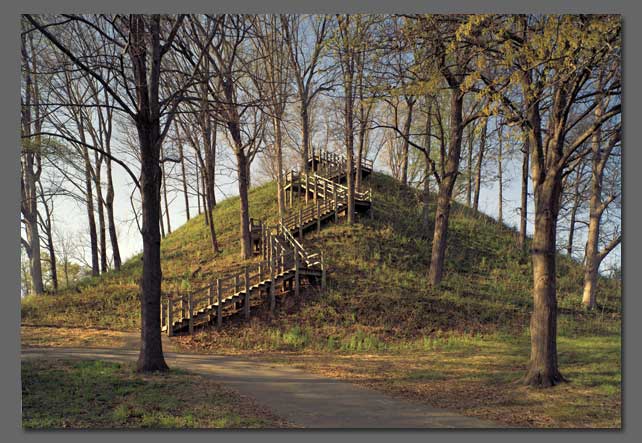
The largest Middle Woodland Period (200 bce - 400 ce) archaeological site in the Southeast. Twelve mounds, a geometric earthen enclosure, and ritual activity areas cover four hundred acres. Five large rectangular platform mounds (ranging in height from 7 to 72 feet) of Middle Woodland age underscores the unique nature of the Pinson Mounds site.

A tornado hit Lawrence county yesterday morning, passing about ten miles south of our house. With cloud tops above 45,000 feet high winds approaching from the southwest destroyed four homes and damaged at least 100 more. Five people were injured but fortunately, nobody was killed. That makes 16 tornadoes touching down in our county in the past 18 years (1990-2008).

Memucan Hunt Howard, (1807-1856) expressed a familiar assumption about the lack of indigenous settlements in this part of the country. "I have heard it said that the Indians, when asked why none of them lived in West Tennessee, replied that it leaked too much. For a time, after I first went there I thought it rained, hailed, thundered and lightened with more wind than I had known elsewhere."

At 14 years old, Howard was working as a surveyor in the woods of western Tennessee when his crew came across evidence of 'the one's who came before'. Howard describes the scene of the discovery. "Each party had a trumpet or horn by which we could generally find each other and the packmen, the more readily - The Trumpets were carried at our backs to prevent it from interfering with the with the compass needle. On emerging from the swamp of the middle fork of the Forked Deer River, about a dozen miles above Jackson when going south-to high land we came to a large bold spring of water and camped between it & a mound some six or seven feet high, and extensive enough for Houses & a small yard, and a large body of beautiful rich level heavy timbered land adjacent to it, with which Pinson was so much pleased that some one of the Company proposed to call it Mount Pinson; we did not see or know of the large Mounds two or three miles further South for months afterward, (...) I saw the large mound a year or two later supposed it to be about 70 or 75 feet high, and was nearly four hundred yards in circumference-near it was a square Mound (I think it was square) about twenty feet high smaller Mounds dikes etc. abounded thereabouts."

These earthworks are some of the oldest evidence of human communities in North America. The park where they are located is often empty and silent,
a good support for walking meditation best visited between autumn and early spring while the forms of the hills are revealed and the bugs are dormant. Like the monolith in 2001, the mounds present an existential gravitas that plunges the mind into a deeper consideration of our evolutionary origins and cultural patterns. Sir Arthur C. Clarke who passed away last winter gave the monolith the same ratios as the UN Building on the East River in Manhattan. On the most basic level, such consecrated mass evokes a sense of the inherent order of the universe including the ability and obligation to come together and conduct this energy in a pure way. The ultimate artifact has been communicated in various ways throughout history, but beyond all drama and formal expression lies the primary mandala of contelligence, the truth of interdependence. Earthen altars invite participation in the great process of cosmic alchemy, bringing together elements both sentient and non-sentient, bridging past and future, spontaneously harmonizing the aggregates, as loving friends, couples, families, communities, and natural systems in expressing what is already whole by nature.

Built up by manual labor, one basketful of dirt at a time, the mounds contain burials and like major complexes in Mexico and Guatemala, reflect an awareness of astronomical patterns framing yearly agricultural and ritual events. Pyramids, medieval cathedrals, stupas and sun temples the mounds embody subtle signatures of the essential, unchanging reality of radiant being at the heart of all change, an invocation of the sacred nature of space and time, the non-duality of life and death, bridging the world above with the one below.
Tikal, Guatemala

Some Native Americans are requesting that the mounds be returned to their original state, free of trees. Tom Kunesh, activist and founding member of the Advisory Council on Indian Affairs (ACTIA) writes, "Mounds are the single most enduring physical legacy of Native American people who lived in what we now call Tennessee. When they were created the people were reminded daily of their passed relatives and leaders and their relationship to the earth and sun. In the past they were kept clean and visited. Now new gods, both foreign and domestic, have replaced the old ones, and the mounds are covered in trees, testimony to their religious and cultural insignificance, proof of the atheism of their descendants."


Pinson Mound, TN

Wednesday, April 02, 2008

The Back Way


Rose early to sit with the ladies, to share coffee and some of the best conversation of the day, before they drove north to work. I processed some email, strapped into the old vandura and cautiously lumber south. A 20 year old GMC, with 160K on the engine and she never breaks down.

Before hitting the asphalt, I pass Zoe's trailer which they were going to move today but recent rains have made the ground too soft. I turn onto an old paved railroad bed which parallels the creek, passing a stretch of white-flowering trees. I decide to cross on the first bridge and climb out of the Saw Valley and take Buffalo Road into town. This is one of many 'back' ways into Lawrenceburg, about 14 miles south in any case. The two lane road dips and climbs through a rural setting over the headwaters of the Buffalo River. Shamefully, I lived in Tennessee for many years before knowing that this was not just a good strong name, but that big hairy buffalo, technically bison, were actually common in this area for over three hundred years, having crossed the Mississippi around 1500 CE. I doubt that the Big Muddy has ever frozen over, so they must have swam. Abundant pasturage springing up on the eastern banks in the wake of intentional burns may have attracted them to make the crossing. These controlled fires were used by Indians to drive and trap animals against a wall of flame. Buffalo herds in the east were smaller than their counterparts on the plains, often numbering 50 -100 individuals. Although never as popular as white-tailed deer in the pantry of woodland tribes, the great beast was soon over-hunted by settlers from Pennsylvania to Florida and so disappeared from the east by the 1820's.

My regard gravitates toward familiar references. The shady hollow with the dangerous curve where Dechen's cousin rented a trailer before his fatal accident. The border of pine trees we planted on the Maxen's pricey spread at the top of the hill, and the little wooden house next door that some younger friends used to rent. Once on Buffalo Road itself, I am extra careful. It is very curvey, there is so much to look at this time of year and I don't drive often. Slow moving vehicles such as tractors are common and there is no shoulder. A glance over the hedge at the right moment reveals the house of an old friend still sheathed in blackboard with no permanent siding. They are poor old hippies. About 15 years ago they were forced to leave the community they had lived in for the previous twenty years, so I helped salvage their old house and then rebuild a few miles down the road. Ivan is an interesting if eccentric fellow and used to come visit me once in awhile, but it has been many years as I don't get on well with his wife, who accompanies the old boy everywhere.

I slowed to pass a few Amish men, one walking on roadside gravel, two out doing business in black horse drawn buggies. Two barefoot boys in an empty wagon emerge from a side road, one holding the reins. Everyone waves back. I am driving through the best farm land in the county. The forest opens up and fields stretch from horizon to horizon, interrupted only by a few white houses. The Amish settled here in the 1940's and their busy homesteads occupy these plains. Men wear beards and hats, women long skirts, sleeves and bonnets. They all dress in dark colors, avoid internal combustion engines, electricity and military service. They do however own a diesel generator to run a large carriage saw and provide truckloads of cheap slab for firewood as a byproduct. It keeps us warm through most of the winter.


Purple and blue chromatics from some dewey wildflowers give way to new greens. Are they more or less brilliant because I do not know their names? Patches of earth near the houses have been freshly turned for gardens. An emerald field of winter wheat, thick and headless rises above the bank. At this time of year, passage on Buffalo Road is like driving in a Grant Wood painting.

Made it safely into town, stopped by the library where I picked up a few books o the Indians of the southeast before heading home the 'front' way; Highway 43, formerly Jackson's Military Road, but that my friends, is a topic for another post.

Wednesday, March 26, 2008

111 over 69

Williamson Medical Center was established in 1957. The Hill-Burton Act provided federal funds to build the hospital, meaning its mission included a focus on providing care without discrimination and regardless of ability to pay. According to their website, Williamson’s beginning was driven by the desire to provide care, to show compassion, to help neighbors. If my experience is any indication, those ideals remain a guiding principle today.
_________

The original idea emerged recently when my friend Fredbear forwarded a hilarious article by Dave Barry about his colonoscopy. A few weeks later, Tenkar brought home a horror tale from work and since I am 52, we decided to 'look into it'. I usually suffice on oxygen and a cup of hot soymilk until early afternoon, so when they told me I couldn't eat anything after breakfast, it wasn't too hard. The worst part was trying to drink a half-gallon of that thick flat lemon-flavored stuff in two hours. Visions of bleached animal skulls near alkali ponds in some western desert; dead from dehydration exacerbated by shitting water faster than it can be replaced.

The nurse wheeled me into the room where the procedure would take place. She was from Oxford Mississippi and used to watch old William Faulkner walk by her school as a child. She squeezed a mound of clear gel onto a tray where a glossy black tube was loosely coiled. Yellow marks and numbers in millimeters along its length provide depth readings.

"Is that it?" "Yep, that's it."

"Can it squirt water?" "Yes it sure can."

She leaned over and hooked a clear line onto a nozzle.

I had been thinking about it last night when I'd wake in the dark, but had not visualized it as black, or so thick. A meshed cable covered in latex, wide enough to contain wiring for a light and camera, a mini-pincer and yes, a water line. Two monitors, dark except for my name in the corner border the bed. I have an iv in my right arm, an automated blood pressure band hooked to a computer on my left; 111 over 69.

"Turn over onto your left side." I could feel the drug moving through me immediately and had no problem surrendering. The next thing I remember is the nurse telling me I can get up and sit back in the wheelchair. I had been unconscious less than an hour.

"So that's all? I'm done?" " Yep, you're done."

I moved from the table to the chair and she rolled me back to a room where Tenkar helped me dress. I was still a little groggy as we walked through the parking lot. I removed the band-aid and gauze where the iv had been and noticed a bright orange plastic bracelet on my right wrist which read SAFE in big black letters.

Like 50 million other Americans, I have no health insurance. But my recent experience with the Williamson County health care system was ideal. The registrar, the doctors, secretaries and all the nurses were angels and made me feel right at home and very comfortable about the whole thing. There was no hassle about our ability to pay; we will work that out over the coming weeks. I was in and out within three hours. All they asked for was $260 up front, and I will let you know the final price after we run the bill through the system. In the meanwhile, everyone seemed to enjoy their job, looked me in the eye and was very kind. You would think we already had socialized medicine in Tennessee.

Monday, March 24, 2008

Benton Chapel

Last week, on a warm spring evening in Nashville, the magnolia trees were in blossom around the chapel on the hill.

We arrived early for the reception in a paneled room with a fireplace, rugs and lots of dark leather furniture. Not only was there no charge, they had a smorgasbord with wine, cheese, pastries and fresh fruit.

All of a sudden, my little group dissolved and I was left alone in this nice space with two black waiters in vests. Ah, disturbing, yet elegant visions of the old South. The irony is so thick here you could build an entire city on it but goes largely unnoticed. They offered me a variety of drinks, including wines and urged me to check out the food. I declined and asked them if they'd seen Obama's speech that morning. Neither of them had, but were interested to know how it went. I told them I agreed with Reverend Wright in the first place but thought Barry O' did a great job of explaining his views.

The older man said, "Hell yeah; like just to offer one small example, what about the Tuskegee men that were shot up with syphilis and never told about it as a government experiment? It isn't like these things have never happened."

The younger guy said, "He's a smart fellow if he can get people to understand."

Amen.

The room filled with all sorts of folks, only a handful of whom I recognized. Loy finally entered wearing a tweed blazer and mustard colored shirt. He stood and talked with some grey haired men in dark suits. I pointed him out to a few folks near me but they all thought I was kidding. I said, no, really, I google him regularly, he's the dude with the beard and big glasses. Finally, Brother Martin went over and said a few words to Mr. Loy and he immediately approached our circle, introduced himself and sat down with us. A gentle hippie buddhist brother now manifesting in an academic's body with a very sharp mind and comprehensive awareness. Told him how much I appreciated his work and the importance of making dharma clarity available and relevant to a wider audience; building practical bridges btwn bald-headed formalism and pop zen-lite. We talked family and culture for a good fifteen minutes. He had spoken in Sewannee the night before.

Before we parted, David invited us all, yeah, you too - up to the Buddhist Peace Fellowship conference in Cincinatti next December.

Wednesday, March 19, 2008

David Loy

David Loy, Tenkar and myself

Last night sangha, family and friends met in Nashville to attend a free lecture at Vanderbilt University by Buddhist teacher David Loy. The talk was entitled Healing Ecology: A New Spiritual Perspective on the Challenge of Consumerism. Although he has traveled throughout the world, this was his first trip to Tennessee. A podcast of the talk is available here. Some of David's articles and books, such as the excellent Buddhist History of the West, can be a challenge to read but last night, his personal sense of ease, a long familiarity with western culture and study of esoteric dharma combined in a very easy, clear explanation of complex ideas. Loy builds modern bridges, so sorely needed at present, revealing important seeds of buddhist wisdom and offering ground for the process of insight into causal forces. A comprehensive understanding of the mind behind the rising tide of sociological and ecological crises is where transformation begins.

Here is an excerpt from an article written a decade ago but more relevant than ever;


According to Buddhism the three roots of evil are lobha greed, dosa ill-will, and moha delusion. Traditionally these are personal problems, but today they must be understood more structurally, as institutionalized.

Our economic system promotes and even requires greed in at least two ways: desire for continuous profit is necessary to fuel the engine of economic growth, and consumers must be insatiable in order to maintain markets for what can be produced. Although justified as raising standards of living worldwide, economic globalization is actually leading to increasing unemployment and environmental degradation. The U.N. Development Report for 1997 pointed out that 1.3 billion people now live on less than one dollar a day, and estimated that there are 93 countries which have a per capita income below what they had a few decades ago.

Long after the end of the cold war, the U.S. federal government continues to devote about half its resources to maintaining an enormously expensive war machine. Most other countries also continue to spend much more on arms than social services. There is no sign that the military-industrial complex, or the lucrative international market in arms sales, will be diverted into plowshares anytime in the forseeable future.

The media that might inform us about these problems distract us with "infotainment" and sports spectacles to promote their real function, advertising. Universities traditionally encourage the critical thinking necessary to reflect on these developments, but in the midst of the greatest economic expansion in history we are told that budget cutbacks are necessary because there is less money available for education. Increasingly, the need to become more market-oriented is diverting academia into corporate research and advanced job training for those eager to join what I will argue is a morally questionable world order.

In short, our global economy is institutionalized greed; our military-industrial complex is institutionalized aggression; our media and even our universities promote institutionalized ignorance of what is actually happening.


David R. Loy

THE SPIRITUAL ROOTS OF MODERNITY
Buddhist Reflections on the Idolatry of the
Nation-State, Corporate Capitalism and Mechanistic Science

David's latest book is Money Sex War Karma Notes for a Buddhist Revolution

Tuesday, March 11, 2008

No Limit


Early this morning Dechen called me to the kitchen window. A brown pickup truck with a plastic amber light on the cab was idling near the end of our lawn. A stout man in a cap and a gloved hand wielding a hammer banging a post into the grass made the sound that got her attention then screwed a sign to it. He's on my land, putting a sign in my lawn. Amazing. What ever might it say? HOME OF FIRST BUDDHIST IN COUNTY perhaps. DISTANT RELATIVE OF GREAT JEWISH POET maybe. Sure, it is a bit odd, but I'm only half-awake and when you are as well-known as I am, you learn to expect this sort of thing. Or similar inexplicable things. Or not. It all seemed relatively unintrusive, quite unlike that telephone polejack out here a few years back, who was a genuine weirdo. Besides, these guys are not necessarily paid to think, but get paid no matter what you think and will invariably tell you that they are just following orders. If you want to complain, call this number, press three and ask for Ms. Nancy.

It was still cold enough and early enough that as much as they love a good rousing bark and snarl at hapless intruders, the dogs didn't want to leave their padded nook on the front porch to badger the dude and at that hour, I felt much the same way. It all looked harmless enough. I really didn't want to have to put on my shoes and jacket and go out there and engage the good fellow. If he is confident enough to live in rural Tennessee and be banging something into my front lawn at this hour, well then, I'll just stay curious and give him the benefit of the doubt. Besides, I'm nursing a cup of hot soymilk here, the only food I will eat for the next six hours; this is definitely not the time to do much else.

It wasn't until he waddled back into the truck and drove off that we could see what the sign said. Whoa. That's a little aggressive, ain't it? We laughed and Tenkar walked out with her camera to record another true-life experience that you might not otherwise believe.
Our land ends in those woods beyond the magnolia. We are the very last house on a dead end street. This sign will be seen by my family alone. As if to admonish us for our pace of preference through this world and urging us to conform to the cultural hyper-drive and not only to get with it but to literally step on it as we risk another excursion into denser and often meaner parts of the grid.

We have never driven this fast on our little road, don't intend to start and don't think anyone else should either. This curvey gravel lane soon ends at the blacktop where the schoolbus stops, a mere quarter mile away. Kids living in the hollow walk this stretch at least twice a day.

Time to give them a call down at the courthouse. In the meanwhile, money is getting tight (again). Watch 'em try and clock us for driving too slow down our own driveway.

Saturday, March 08, 2008

Primeval Dixie

Late last night snow;
this morning
brightness pouring in

through every window.

***

Mankind suffers from the narrow viewpoint afforded by conditional consciousness and the largely egological concerns of this present life. We habitually ignore or overlook those aspects of the cosmos which do not relate to the present pursuit of money, food and sex. Through the subtle complexities of causality, one of the more obvious consequences of this mass fixation on self is the wave of extinctions now taking place on all continents. Short-sighted, expedient actions and decisions made by ordinary people are irreversibly changing and impoverishing us all far into the future. In a saner world, awareness of this situation would immediately lead to a global summit to direct all available resources toward measures which might slow (if not stop) this trend, beginning with attention to the most vulnerable species. Like the dark of the moon, the moment passes and it is already tomorrow.

We will all do everything we can while true transformation will not come about through any mechanical process. The nature of consciousness itself provides the key. Beyond all the hope and hype, the media is fixated on absurdities, congress is chasing down baseball players while all the Presidents men conduct business as usual. It doesn't take a Buddhist to see that on the political front, things are so locked up, fixated on fear, and dumbed down, whatever we might think is practically irrelevant; thus the angle of this blog.

It is now as it has always been, a matter of ongoing education, self-understanding in the widest sense and individual-cum-collective spiritual evolution. It has certainly been said before and I only confirm it here, that the pure land, the great beyond, the final frontier of infinite wilderness, is certainly within you. So without getting astronomical, let's roll it back a few years to get some context on this place. A wider, prehistoric perspective deepens appreciation of the fleeting present.


A few extinct North American carnivores up against a grid of two foot boxes. L-R: Dire wolf (Canis dirus), sabre-toothed cat (Smilodon fatalis), short-faced bear (Arctodus simus), cheetah-like cat (Miracinonyx sp.), and the American lion (Panthera leo atrox). (Turner and Anton, 1997).

Ice ages have been happening periodically for the last two million years. Twenty thousand years ago, massive glaciers two thousand feet thick covered all the land north of the Ohio. Dark evergreen and the smoky blues-greys of coniferous forests covered most of the southeast. An endless sea of spruce, jack pine, and fir extended south of the Tennessee River to 34°N latitude. Deciduous species dependent on temperate conditions either 'migrated' further south or died off. In some parts of the earth, such as northern Europe or central Asia, all escape routes were blocked by massive rocky upthrusts like the Alps, the Tien Shan and Himalayan ranges which are oriented on an east-west axis. Species such as sweet gum (Liquidambar), tuliptree (Liriodendron), and hemlock vanished from Europe completely.

In contrast, the general north-south orientation of the Appalachians provided passage for refugee species during glacial maximum. The northern margins of these temperate zone deciduous forests persisted in sunny havens throughout the full glacial in south—facing pockets and gorges of the highlands and mountains of southern Tennessee. As the glaciers began melting, powerful outwash streams carried Canadian shield boulders hundreds of miles across Kentucky and distributed the glacial till over a wide flood-plain. Relatively undisturbed since the paleozoic, gravity and water work the grooves, draining plateaus, redistributing the earth. A wide range of soil types develop supporting what will become one of two of the greatest temperate forest regions on earth, (the other is in China) displaying great biodiversity. As temperatures warmed, the competition for territory was renewed. The broadleaves, blessed with flowers and co-operative insects began pushing north. Through the magic agency of the living seed enclosed within a fleshy carpel, borne by winds, rivers, mammals and birds, this complex engine of organic productivity known as the mixed mesophytic forest gradually dominated the temperate zones of Turtle Island. Collecting energy from the sun and drawing solutes up from the earth, attracting weather, storing water, providing homes and sustenance for countless life forms.

South of the glacier, an amazing variety of megafauna roamed the marshy grasslands and forest, including four genera of giant ground sloths as big as hippos, giant beavers with six-inch teeth, two types of llama, 'stag moose' - actually a deer taller than a man, dire wolves, mastodons, wooly mammoth, American elephants, saber tooth cats, and the lion-sized scimitartooth (Homotherium), four species of musk-ox, yak like those still found in Tibet, giant jaguar, cheetah like those still found in Africa, capybara and peccary species which still exist in South America, native camels, even maned lions. Lumbering ten foot armadillos, water-loving tapirs, four-horned antelope, horses, asses, a huge species of bison, six genus of longhorn, five kinds of deer, and condors with sixteen-foot wingspans. Perhaps most fearsome of all was the short-faced bear (Arctodus) measuring six feet at the shoulder, eleven when standing, the largest land predator on the continent throughout the ice age.

One thousand years after humans arrived, most of the animals mentioned above, seventy species (80-95% of the megafauna) - disappeared completely from North America, very likely due to a combination of over-hunting, and climate change. Recent evidence indicates an extra-terrestrial impact around 11,000 BCE may have been a major contribution, by generating a mini- 'nuclear winter'.

Russell Cave in NE Alabama provides the first evidence of human habitation in the southeast. Hunter-gatherers occupied it as early as 6500 BCE. Using short spears with sharpened stone points propelled by atlatls, combined with masterful cunning, paleo-hunters were extremely proficient at bringing down big game. By the time that little band of twenty five or so moved into Russell Cave, there was plenty of smaller game like fox, squirrel, skunk, raccoon, rabbit, and bobcat - animals you can still find (in far less numbers) in the woods today. They also fished and gathered nuts, fruit and berries, wove baskets and were fond of wild turkey. White-tail deer and black bear, the only larger animals remaining in the region were both hunted seasonally. Fortunately, both of these four-legged cousins are still with us today.

Tuesday, February 26, 2008

Chickasaw Bluffs


"By 1800 there was little danger of the Chickasaws warring against either the whites or other Indians. Trade was the most immediate concern, and in 1802 the United States opened the Chickasaw Bluffs Trading House near Fort Pickering. Government trading posts also played a vital role in encouraging Indian land cessions, and President Jefferson was disarmingly candid in this regard. He urged the establishment of a Chickasaw post “for furnishing them all the necessaries and comforts they may wish (spirituous liquors excepted), encouraging them and especially their leading men, to run in debt for these beyond their individual means of paying.” The Indians would then cede more lands to satisfy their obligations. The effectiveness of this policy was almost immediately apparent. In 1805 the Chickasaws ceded land in Middle Tennessee to offset a debt of $12,000. The Chickasaw Bluffs trading post continued to offer on credit an array of high quality goods—the Chickasaws were discriminating customers—and each year Indian indebtedness rose by several thousand dollars. Struggling to meet their material needs and financial obligations, Chickasaw males used their West Tennessee hunting lands to good effect. In 1809 the trading house at the bluffs ranked first among fourteen U.S. trading posts, with more than $12,000 worth of pelts."

-The Chickasaws

Civilization of the American Indian Series, V. 109
by Arrell Morgan Gibson,
Norman, Okla. University of Oklahoma Press, 1981.

Sunday, February 24, 2008

Ayali


imagine
being so driven
so desperate
using almost anything
money, liquor, guns, and lies
to take land from people
who'd been here for over 500 years.

imagine
new people
occupying that land
five six seven ten generations
slowly learning what
money, liquor, guns and lies
will buy

and now we
after a half-life in these hills
still under the influence
know almost nothing
of the first people who
laughed and sang here
not so long ago
almost nothing
of their sacred ways and stories
or their word for the mystery

Do you even know how to say goodbye in their language?

Wednesday, February 20, 2008

Garab Dorje


The skies are too cloudy to see tonight's lunar eclipse but I did not want to let the day pass without paying homage to one of mankind's best friends. Recalling his central message, contemplating his inner experience and sharing awareness that such a one once walked this earth. Isn't that the point? Today the Nyingma lineage of Tibetan Buddhism celebrates the anniversary of Garab Dorje. Born in the region by the Aral Sea in the centuries before Christ, he is the source of the 'Great Perfection ' or Dzogchen teachings. Due to the influence of teachers such as Padmasambhava, Vimalamitra, Longchenpa and Jigme Lingpa, this sublime method of awakening to full Buddhahood flourished for over a thousand years in Tibet, widely renowned as the highest form of the three vehicles of Buddhist practice. Garab Dorje translates as Indestructible Happiness. The essence of his teaching was summarized in a final transmission known as Striking the Essence in Three Words. Namkhai Norbu Rinpoche renders the triad as follows;

1. Direct introduction to the primordial state is transmitted straight away by the master to the disciple. The master always remains in the primordial state, and the presence of the state communicates itself to the disciple in whatever situation or activity they may share.

2. The disciple enters into non-dual contemplation and, experiencing the primordial state, no longer remains in doubt as to what it is.

3. The disciple continues in that state of non-dual contemplation, the primordial state, bringing contemplation into every action, until that which is every individual’s true condition from the beginning (the Dharmakaya), but which remains obscured by dualistic vision, is made real, or realized. One continues right up to Total Realization.

Monday, February 18, 2008

Sri Ramakrishna


Today is the 172nd anniversary of the birth of the Great Swan, the incomparable Sri Ramakrishna (1836-1886). If you are not yet familiar with this man, do yourself a favor and take the time to become acquainted.Even at this distance, he will make you laugh and open your heart, inspiring and deepening your practice, no matter what path you tread. Be delighted and enlightened by his magnetizing presence, and please do so with my full encouragement. He is one of a handful who I recognize as a fully enlightened Buddha; a true gem.

"Suppose a thorn has pierced a man's foot. He picks another thorn to pull out the first one. After extracting the first thorn with the help of the second, he throws both away. One should use the thorn of knowledge to pull out the thorn of ignorance. Then one throws away both the thorns, knowledge and ignorance, and attains vijnana.[1] What is vijnana? It is to know God distinctly by realizing His existence through an intuitive experience and to speak to Him intimately."


- The Gospel of Sri Ramakrishna

[1] S. vijnana translates as consciousness